

The prerequisite for the discussion is that you know what is Tenmoku and what is not.
Regardless of the price, afraid of offending someone.
Regardless of the quality of the master's work, you will understand after seeing it.
This article originated from the fact that the author is asked every day by many friends how to choose Tenmoku and some more detailed questions. These questions are often not found online or different people have very different answers. The author shares some suggestions based on personal experience. (In fact, I am very confident that this article will be very practical). At the same time, the list mentioned in the article is the result of recommendations from more than 20 masters, and their skills are recognized as representative in the industry.
1. Look at the glaze color.
This is almost the primary criterion for selecting all porcelain, but the author does not want to say which glaze color is better because there is no answer to this type of comparison due to differences in aesthetics. However, we often care too much about who is better or worse, which is not the attitude that a mature Tenmoku collector should have. If you have this mindset, I want to remind you that the disadvantage is that you are too eager to find a standard answer, and the person who gives you this answer can influence your judgment and even preferences. The advice I can offer is to suggest ways to choose a glaze color that you like:

"The color of the Tenmoku should be black or green, and the rabbit hair markings should be even and smooth to be considered top-quality." We have all heard this sentence, but it does not have much meaning for us in terms of selecting the type of rabbit hair we prefer. The reason is straightforward: this was said by Song Huizong, who has seen far more Tenmoku than we have. Therefore, do not trust anyone's words. You must have enough confidence in your own preferences because your preferences are what make collecting Tenmoku enjoyable for you, and other people's preferences have nothing to do with us.
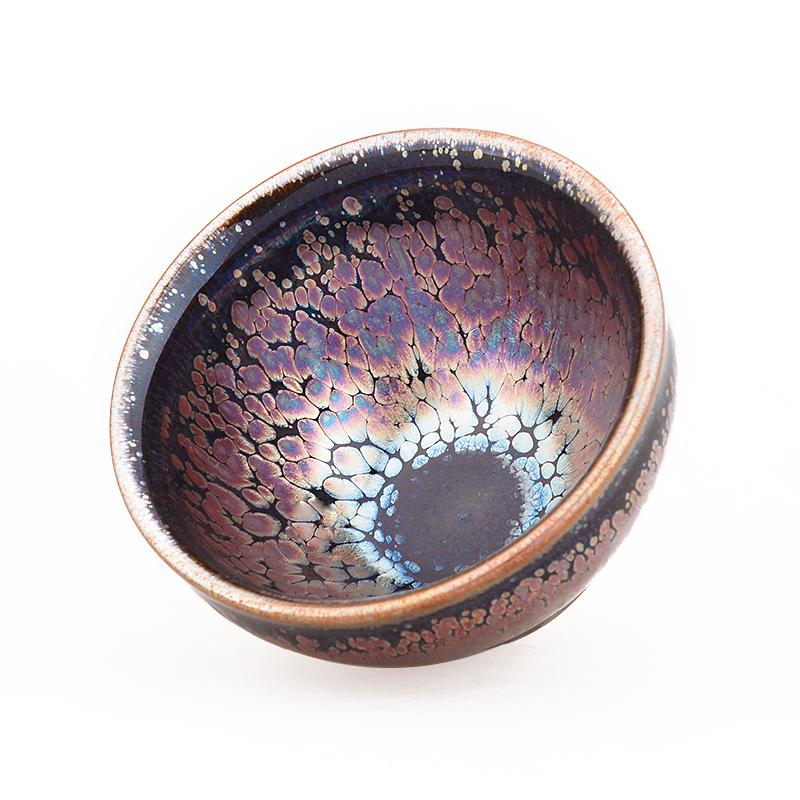
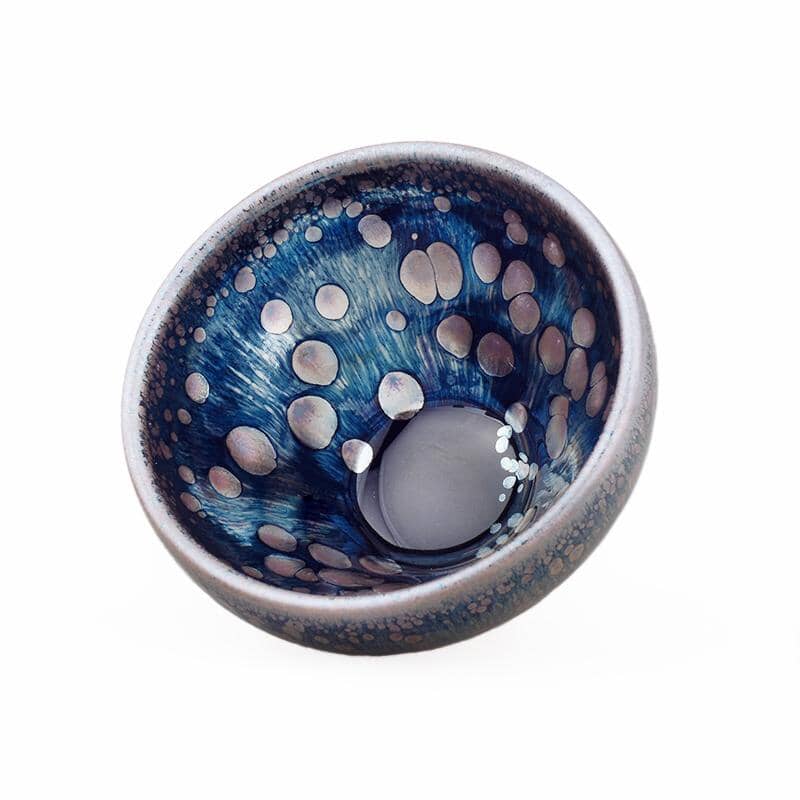
There are several types of rabbit hair markings, including yellow, silver, blue, red, gold, and others. Most masters produce Tenmoku with yellow rabbit hair markings, while silver rabbit hair markings are relatively rare.
Degree of uniformity.
In most cases, the more uniform the oil drop markings on Tenmoku, the better, but this is not absolute. There are many unique Tenmoku with unevenly distributed oil drop markings that are aesthetically pleasing.
The size of the oil drop markings.
The size of the oil drop markings is related to the firing temperature, atmosphere, and glaze materials, with temperature having the greatest impact. The higher the temperature, the larger the area where the crystallization adheres to the black glaze surface and the more the oil drops flow and accumulate. However, larger oil drops do not necessarily mean they are more difficult to produce. When selecting Tenmoku, it all depends on personal preference, whether it be small, intricate drops resembling a starry sky or large, patchy drops.
" into English is "glaze color".
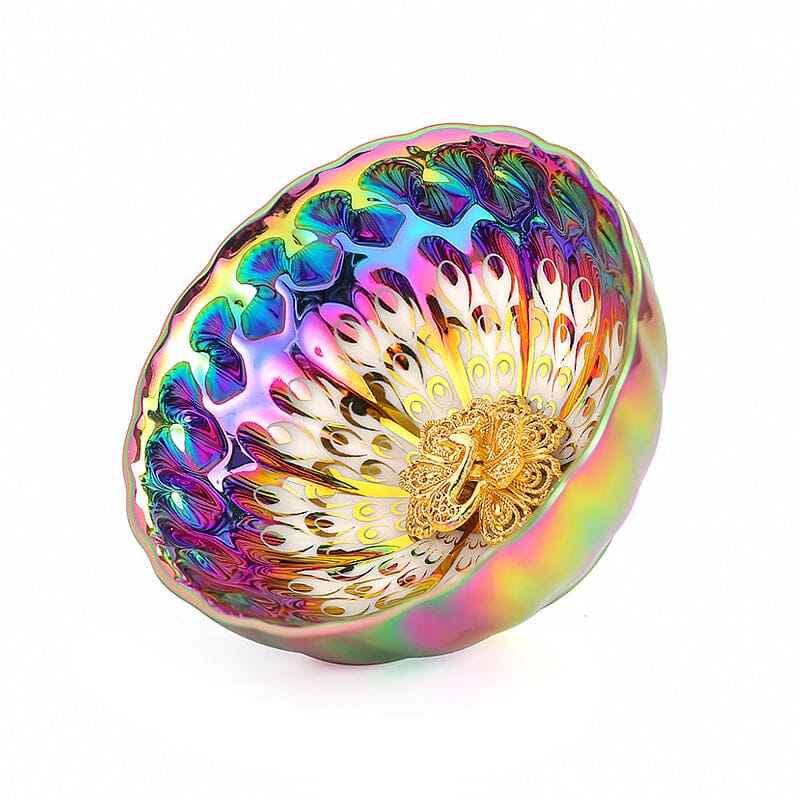
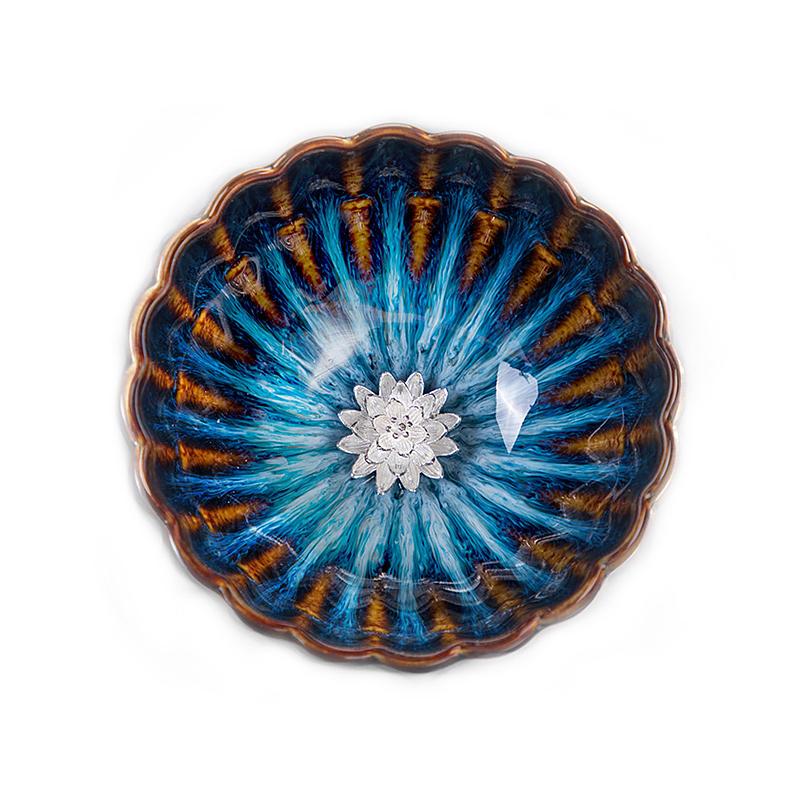
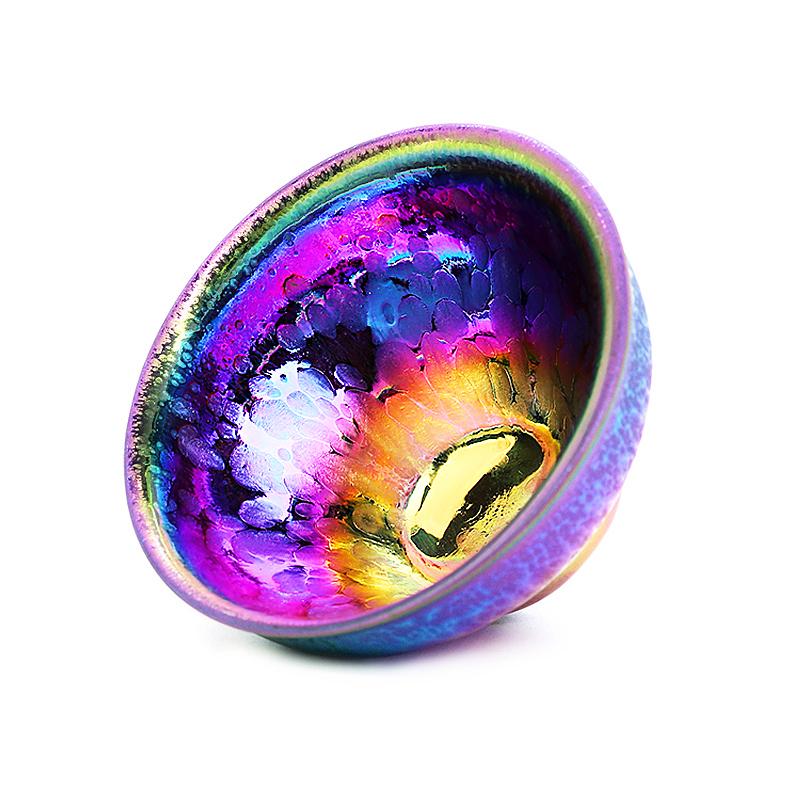
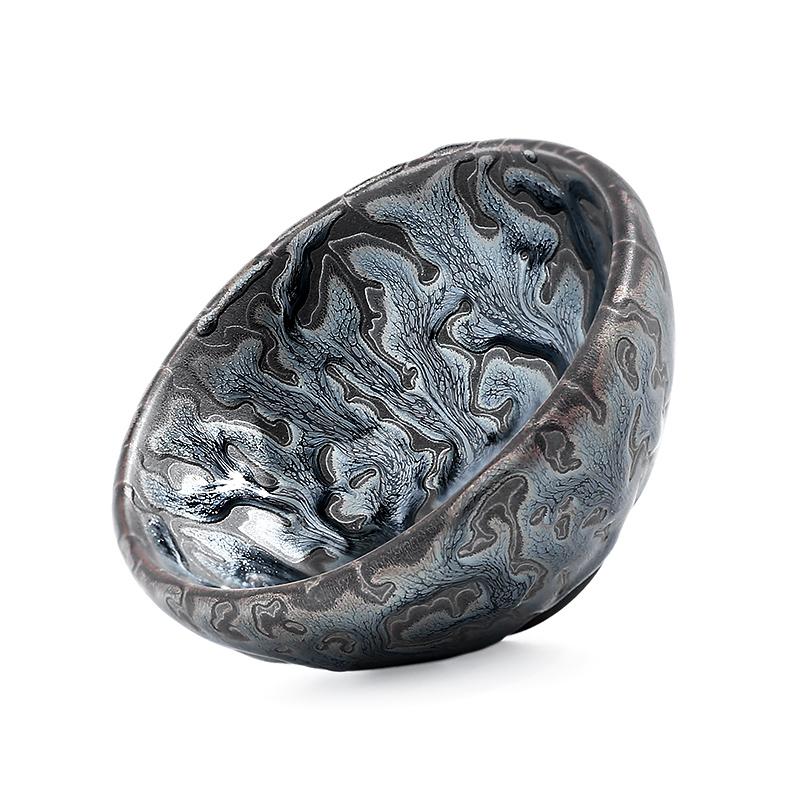
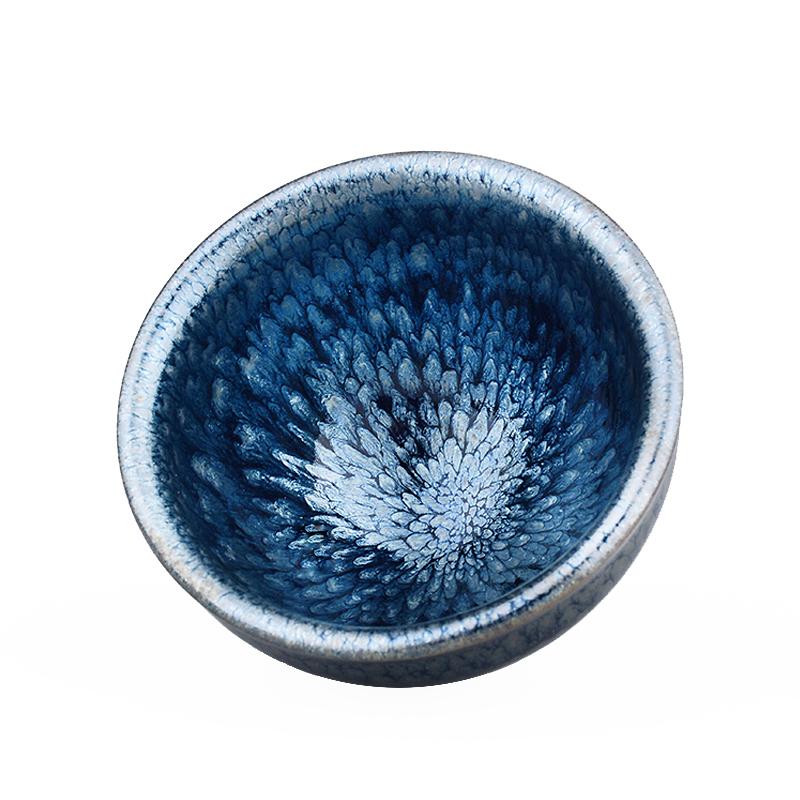
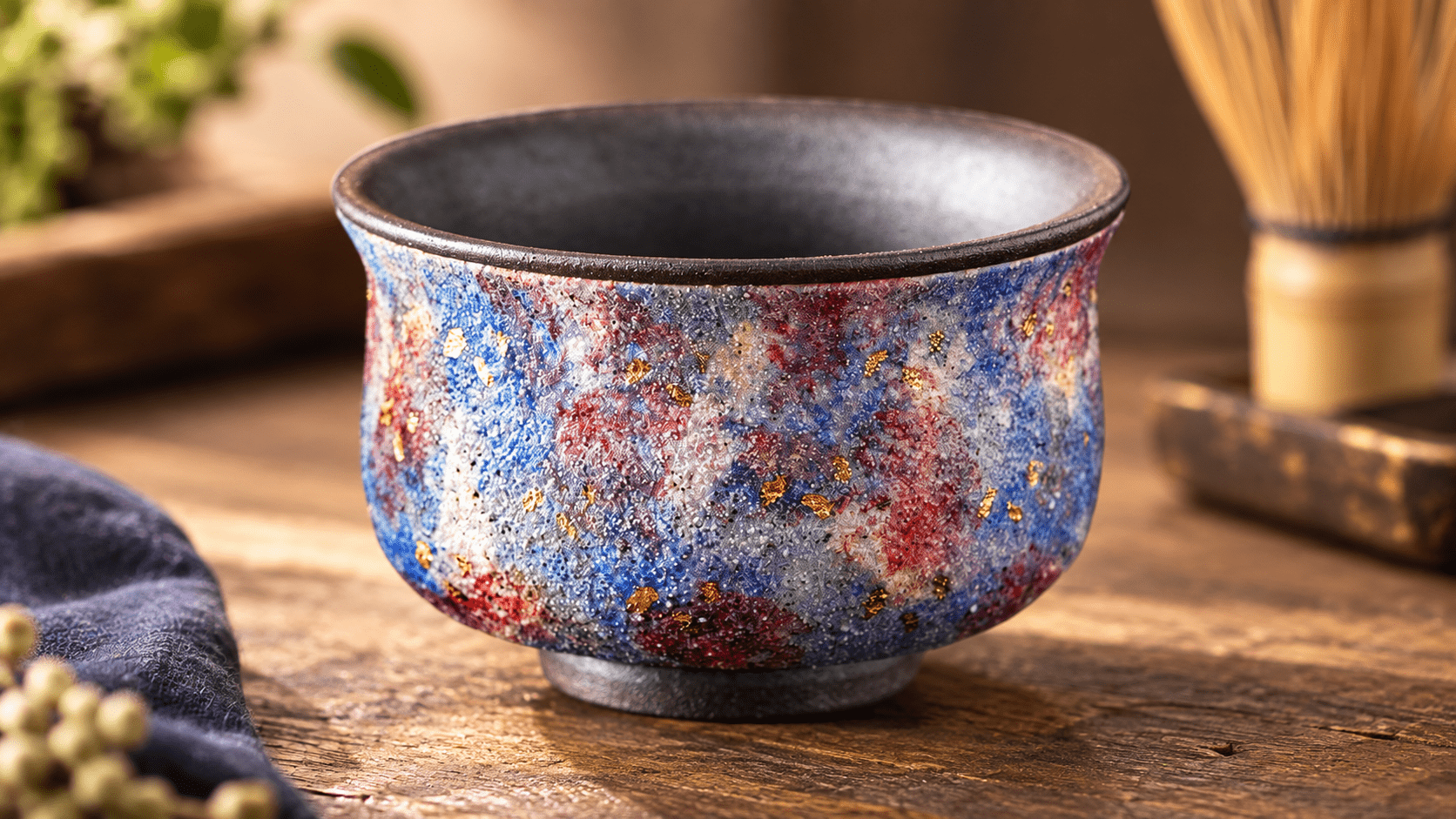
There are currently dozens of glazed colors available on the market, mainly blue and silver, as well as colors such as gold, yellow, red, green, and rainbow. When choosing, it is recommended not to deliberately pursue unique colors.

Crystalline texture
Crystalline texture is actually a rather vague concept. It's difficult for me to explain it clearly, so I'll use the term "vitrification effect" as a compromise. Generally speaking, the heavier the reducing atmosphere, the poorer the vitrification effect, and the higher the activity of the crystal. Therefore, it is difficult to accurately distinguish the quality of the texture.

2. Viewing the shape of the object
The shape of the object can be divided into practical utensils (with a diameter of 6-12cm) and ornamental utensils (above 12cm) according to size. Within the practical utensil range, the mainstream shapes are the straight mouth, the flared mouth, and the inward-curving mouth. Cup designs such as the Yulan cup,
3. Worth noting
All the works of the local masters in Jianyang are made of iron clay. The reason is simple: the clay used is all taken from the local area, so it is impossible to go to other places to dig clay. The biggest characteristic of the local clay is its high iron content, which is beyond doubt.
Do you need to check if it is made of iron clay?
Judging whether it is made of iron clay by observing the color of the foot is not accurate, because reduction firing and oxidation firing can lead to different colors of the foot. The reason why there is a saying of "gray foot" is that most of the products on the market are oil drop products, and reduction firing is used, so the foot appears gray. The foot may be yellow, brown, or other colors under oxidation firing or weak reduction firing.
Using a magnet to determine if it is made of iron clay is also not accurate. This is a very intuitive but extremely inaccurate method because the thickness of the body, the thickness of the glaze, the magnetic properties and size of the magnet can all affect accuracy.
Do you need to check the reputation of the master?
Yes, usually it is recommended to check the reputation of the master. Generally speaking, the more famous a master is, the more reliable he/she is. A master's reputation comes from his/her works being recognized in the market and widely spread by people. Therefore, the technical finesse, packaging, and promotion are relatively strict.
Don't worry too much because the development time of Tenmoku is still relatively short, and it has only been popular for the past 3-4 years. The technical level of most masters is not significantly different. It usually takes at least 20 years for a profession to show significant gaps in skills. Being too concerned about reputation may increase the risk of being cheated.
Don't miss the works of new masters just because they are not yet famous. Currently, the number of Tenmoku masters is growing at a rate of nearly 100 people per year. They have many works with good quality, and they are relatively advantageous in terms of price.
4. Suggestions from the editor
Don't compare prices, especially for beginners. This may cause some backlash when mentioned, but let me explain further. Firstly, for beginners, the opportunity to find a bargain without being scammed is almost non-existent, so don't count on it. Secondly, each master has a relatively independent pricing system, so comparing prices between different masters does not necessarily indicate any problems. Thirdly, the prices of Tenmoku from the same master may also vary due to differences in quality and target audience. In this case, you can choose to buy those with high cost performance, but it is also easy to buy those with poor quality at a low price. Therefore, you should consider multiple factors when making your purchase.



Share:
How to Identify Handmade Tenmoku
How to Use A Tenmoku Teacup