

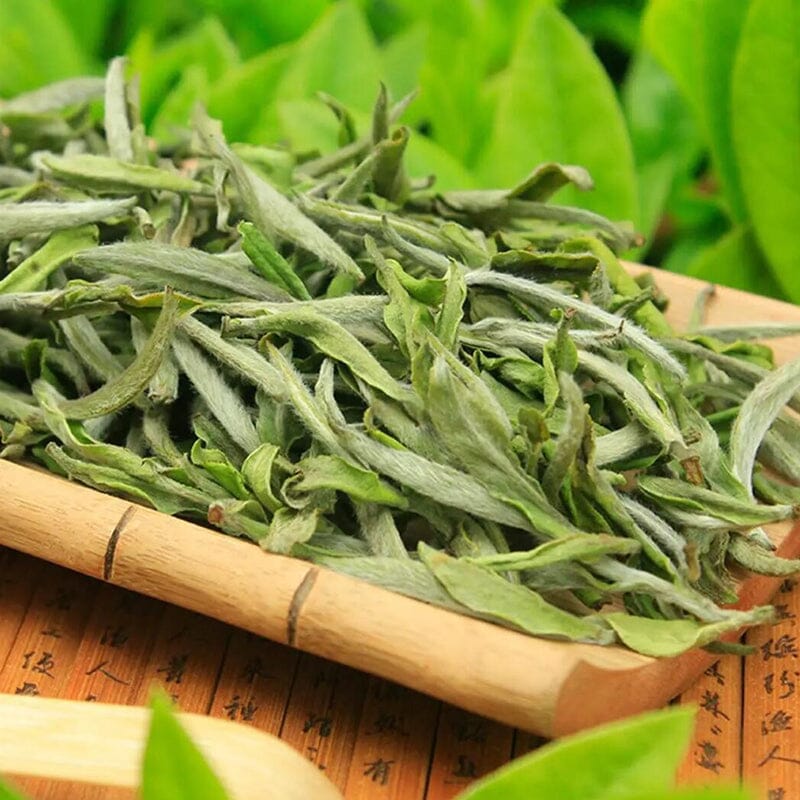
Silver Needle (Baihao Yinzhen), as a treasure in white tea, is famous for its plump buds, dense white hairs (baihao), and sweet taste. To fully showcase its unique charm of "hairy fragrance and honey rhyme", it is necessary to first understand the classification logic of white tea, and then master core steps such as warming utensils, moistening infusion, and brewing. This article will systematically explain the variety system of white tea, the characteristics of Silver Needle, and basic brewing techniques, helping you get started with this "naturally formed" classic white tea.
1. Classification System of White Tea: Variety Differences Based on Picking Standards
Silver Needle: Picks the tenderest and plump single buds, with full buds densely covered with white hairs (baihao), being the highest-grade variety in white tea;
White Peony: Picks tender shoots with one bud and one leaf or one bud and two leaves, with buds and leaves connected, having both the hairy fragrance of buds and the sweetness of leaves, with rich flavor layers;
Tribute Eyebrow: Mainly consists of one bud with two or three leaves, with larger leaves and a lower proportion of buds than White Peony, having a more mellow taste;
Longevity Eyebrow: Picks more mature leaves and tender shoots, with few buds and large leaves, having a rich tea soup taste and strong durability.
Raw Material Relationship: All white tea varieties come from the same tea tree, picked in the order of "buds→bud-leaves→tender leaves" — first picking buds to make Silver Needle, then picking remaining bud-leaves to make White Peony, and finally picking mature leaves to make Tribute Eyebrow and Longevity Eyebrow;
Process Commonality: The four varieties share the same processing technology (mainly sun-drying and withering, without frying or rolling), and the differences in appearance, aroma, and taste of finished products are only caused by different picking standards;
Easily Confused Points: It is necessary to distinguish between "variety differences" and "process differences". The grade of white tea is determined by the tenderness of raw materials rather than the complexity of the process.

2. Preparation for Brewing Silver Needle: Key Roles of Warming Utensils and Moistening Infusion
(1) Warming Utensils: A Basic and Necessary Step
Core Purpose: Heat the gaiwan and other utensils with hot water to raise and stabilize the utensil temperature, avoiding the subsequent cold water from reducing the water temperature, which affects the unfolding of buds and aroma release;
Utensil Selection: It is recommended to use a white porcelain gaiwan (100-120ml is appropriate) for three reasons:
White porcelain has no adsorptivity and can truly present the sweet aroma of Silver Needle;
The large opening of the gaiwan facilitates observing the "upright" posture of buds in water;
The gaiwan dissipates heat quickly, and the temperature can be adjusted by opening the lid to avoid over-ripening of buds;
Operation Standards: Rinse the inner and outer walls of the gaiwan, fairness cup, and tasting cup evenly with boiling water, ensuring every corner is soaked. After warming, pour out residual water and retain the residual temperature of the utensils.
Core Role: Through short-term infiltration, let the tight buds initially absorb water and expand, breaking the waxy layer on the surface of the buds, preparing for the precipitation of effective substances (such as amino acids and tea polyphenols) during formal brewing;
Operation Method: Put 5-6 grams of Silver Needle into the gaiwan (about 1/5 of the gaiwan's capacity), pour boiling water until completely submerging the buds, immediately pour out the tea soup (soaking time does not exceed 5 seconds), and this soup is not for drinking;
Professional Details: The action during moistening infusion should be quick to avoid excessive water absorption by buds leading to a weak taste in subsequent brewing. After pouring out the tea soup, you can observe that the buds are slightly unfolded and white hairs begin to appear, indicating successful "awakening".
3. Formal Brewing of Silver Needle: Precise Control of Water Injection, Time, and Tea Pouring
Water Flow Control: Adopt the method of "low and slow pouring", slowly inject boiling water (water temperature 90-95℃ is appropriate) along the inner wall of the gaiwan. The water flow is as thin as a "silk thread" to avoid direct flushing of buds causing white hairs to fall off. White hairs are an important source of aroma and sweetness of Silver Needle; excessive falling off will make the tea soup turbid and the taste weak;
Water Volume Standard: Inject water to 4/5 of the gaiwan's capacity, leaving space to avoid soup overflow and providing enough space for buds to unfold;
Water Temperature Selection: Silver Needle buds are delicate, so the water temperature should not be too high (exceeding 95℃ may cause buds to be scalded and produce a stuffy cooked taste). Boiling water at 90-95℃ can stimulate the hairy fragrance and protect the bud structure.
Time Control: Silver Needle buds are plump with low water content and take longer to absorb water than ordinary tea leaves, so the soaking time needs to be appropriately extended:
First infusion: 30-40 seconds (after moistening infusion, buds have initially unfolded, but the release of internal substances is slow);
Second infusion: 25-30 seconds (after buds are fully absorbing water, the release speed of substances accelerates, so the time can be slightly shortened);
Subsequent infusions: Increase by 5-10 seconds for each infusion until the taste fades significantly after the sixth infusion;
Observation Points: During soaking, you can observe the state of buds in water — high-quality Silver Needle will "stand upright" in water with the tip upward and white hairs suspended, forming a beautiful scene of "silver floating in the cup", which is an intuitive basis for judging quality.
Tea Pouring Skills:
Use a fairness cup to equalize the soup: When serving soup, completely pour the tea soup from the gaiwan into the fairness cup, then distribute it to tasting cups after mixing through the fairness cup, avoiding the first poured soup being light and the later being strong, ensuring consistent concentration of each cup of tea soup;
Thorough Soup Serving: When pouring tea, tilt the gaiwan until no tea soup drips to avoid residual tea soup continuing to soak in the gaiwan, leading to an overly strong taste in the next infusion;
Tasting Process:
Color Observation: The soup color of Silver Needle is light yellow or light apricot, clear and transparent, with fine white hairs suspended on the cup wall. High-quality tea soup has no turbidity or precipitation;
Aroma Smelling: Gently shake the tasting cup to feel the fresh hairy fragrance (similar to orchid or honey fragrance), which is high and lasting without grassy or off-odors;
Taste Savoring: Sip in small mouthfuls, allowing the tea soup to fully contact the tip of the tongue (to feel sweetness) and the tongue surface (to experience smoothness). High-quality Silver Needle has a sweet entrance, obvious aftertaste in the throat after drinking, and the hairy fragrance remains in the mouth for a long time.

4. Knowledge Summary: Key Points of Silver Needle Brewing
The way of brewing Silver Needle embodies "respect for nature". From understanding the raw material differences between it and other white tea varieties, to gently carrying it with a white porcelain gaiwan; from the quick awakening of moistening infusion to the hair-protecting skill of low and slow pouring; every link is guarding its natural and unadorned authenticity. When you watch the plump buds stand upright in hot water, smell the fresh hairy fragrance pervade, and feel the sweet aftertaste of the tea soup in your mouth, you will understand why Silver Needle is called a treasure in white tea — its brewing is not only a display of techniques but also a gentle response to natural gifts.


Condividere:
Brewing Oolong Tea – Dongding Oolong (Part II): Advanced Guide to Utensil Selection and Quality Identification
Brewing White Tea – Silver Needle (Part II): Multi-Infusion Techniques and Process Analysis