


If you’re looking for a tenmoku tea bowl for gongfu tea or as a thoughtful gift for a tea lover, you’ve likely stumbled across stunning oil spot and hare’s fur patterns. But here’s the challenge: the market is flooded with fakes. I’m Tenmokus Editorial Team, a collector and tea enthusiast who’s handled hundreds of Jianzhan cups, from priceless Song Dynasty antiques to modern reproductions. Whether you’re holding a glossy black bowl that claims to be an oil spot tenmoku cup or a finely crafted handmade tenmoku tea cup for your next session, knowing the difference between a genuine, iron-rich glaze and a chemical copy is essential.

What Exactly Is a Tenmoku Tea Bowl?
Before we dissect real vs fake, let’s get our terms straight. A tenmoku tea bowl is a type of black-glazed stoneware originally made in the Jian kilns of Fujian, China, during the Song Dynasty (960–1279 CE). Japanese monks traveling to China brought the bowls back and named them after Mt. Tianmu (spelled “Tenmoku” in Japanese). In Japan, they became central to the tea ceremony, revered for their deep, meditative aesthetics. Today, “tenmoku” is the Western umbrella term for these iron-saturated glazes that produce shimmering patterns—most famously oil spot (yohen) and hare’s fur (nougime). An authentic jian zhan is always handmade, never mass-produced, and the magic happens inside a dragon kiln where intense heat and reduction atmosphere coax iron crystals to the surface.
Real vs Fake Tenmoku: The Tale of Two Bowls
When you shop for a tenmoku tea bowl for sale, you’ll see two extremes: a $15 “oil spot” cup on a big-box marketplace, and a $200+ artisan piece from a dedicated ceramicist. The difference isn’t just branding—it’s in every molecule of the glaze.
| Feature | Authentic Jianzhan | Fake / Industrial Imitation |
|---|---|---|
| Clay body | Deep brown, unrefined iron-rich clay with visible grit | White or pale porcelain, often hidden under a black engobe |
| Glaze formation | Crystalline iron blooms formed in a reduction kiln at 1300°C+ | Glossy black paint, chemical spots, or heat-transfer decals |
| Oil spot pattern | Individual silver or iridescent rings that appear to float; variable size | Uniform black dots, perfect circles, or a “frog egg” cluster that looks printed |
| Foot (bottom ring) | Coarse, unglazed rim, often bearing the artist’s carved mark | Smooth, machine-cut foot, sometimes entirely glazed |
| Sound | Clear, ringing chime when tapped lightly | Dull “thud” like plastic or thick porcelain |
| Texture | Glaze feels like orange peel under fingertips | Slick, bubble-free, glass-smooth surface |
| Price | $80–$500+ for a quality handmade piece | $10–$30 |
I once helped a friend identify a “tenmoku” bowl she bought in a tourist market in Kyoto. It had the trademark black sheen, but the oil spots were perfectly round and completely flush with the surface—no depth, no light play. She’d been sold a stencil-sprayed reproduction. That’s when I realized how important it is to demystify jian zhan oil spot vs fake differences for anyone entering this world.
How to Identify Real Jianzhan: Four Practical Tests
The good news? You don’t need a lab. With your senses and a little know-how, how to identify real jian zhan becomes second nature. Here’s my quick checklist.
1. The Clay Body Never Lies
Flip the bowl over. A genuine authentic jian zhan uses locally dug ferruginous clay that fires to a dark chocolate or reddish-brown color. It feels slightly rough, almost sandy. Fakes hide behind white porcelain—if you see a pure white chip or a black glaze covering a white body, walk away. The foot should be partially unglazed and slightly irregular, never machine-perfect.
2. Glaze Under a Magnifying Glass
Real oil spots are clusters of magnetite crystals that have grown like snowflakes. Under a 10x loupe, you’ll see dendritic, feathery edges. Fake ones look like polka dots printed by a bubble-jet printer. Hare’s fur streaks in genuine Song Dynasty style bowls exhibit subtle color gradations—silver, blue, and even purple tones depending on the reduction atmosphere. Imitations are all one shade.
3. The Water Test
Pour hot water into the bowl and observe the glaze. A handmade iron-rich glaze will slightly “breathe”—you might notice the oil spots become more vibrant as the heat activates the crystalline structure. Fakes stay static. Also, real tenmoku absorbs a tiny bit of water at the unglazed foot, while a vitrified fake stays bone-dry.
4. Sound and Heft
Tap the rim gently with a fingernail. An authentic Song Dynasty-inspired tenmoku tea bowl rings with a sustained, bell-like tone because the high-firing vitrified body is dense yet elastic. Fakes thunk. In your hand, a real bowl feels substantial but balanced; a fake often feels lighter because the clay is thinner or the material is slip-cast.
Oil Spot Tenmoku Cup: Genuine Kiln Transformation vs. Fake Patterns
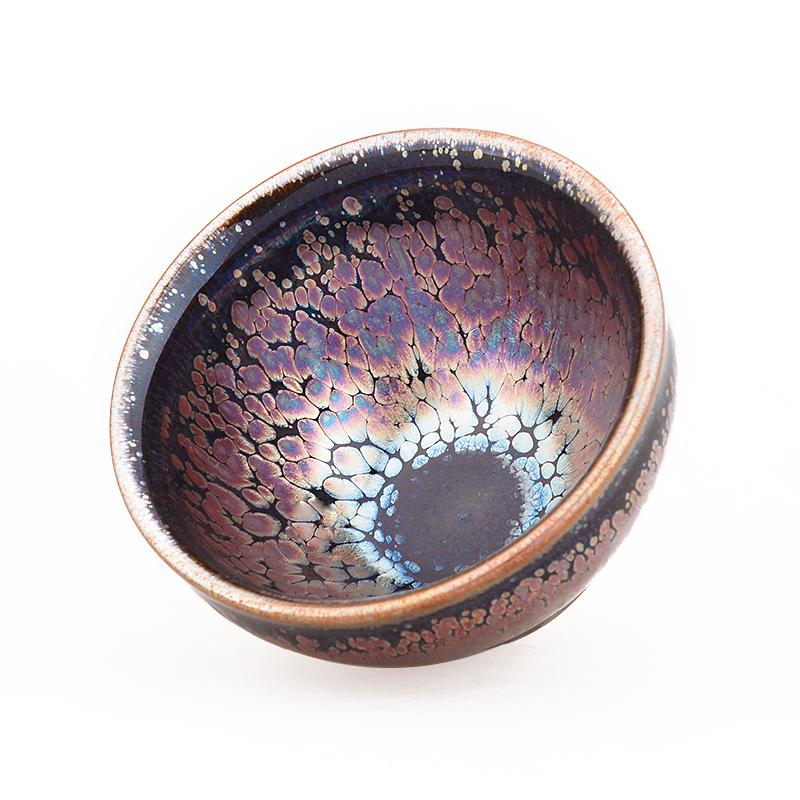
The oil spot tenmoku cup is the most counterfeited style. Why? Because those silvery bubbles look magical. True oil spots are born when iron oxide supersaturates the melt and bubbles of oxygen erupt, leaving behind a ring of crystalline hematite. The patterns are never identical—like galaxies, each one unique. When you rotate the bowl in sunlight, you should see a silvery “rainbow” phenomenon called tenmoku yuteki in Japan.
Fakes, on the other hand, are often produced by silk-screening an iron-oxide paste onto a pre-glazed black cup and re-firing at low temperature. The spots sit on top of the glaze like stickers, and they lack any dimensionality. If the cup’s interior shows the exact same pattern repeated in a geometric grid, it’s a decal. I always tell buyers: an oil spot tenmoku cup should feel like looking into a starry night sky—never like a polka-dotted mug from a mall store.
Hare’s Fur vs. Oil Spot: Which Glaze Pattern Suits You?
Once you’ve confirmed authenticity, the next decision is which style speaks to you. Both are iron-rich glazes, but the visual effect and tea-pairing experience differ.
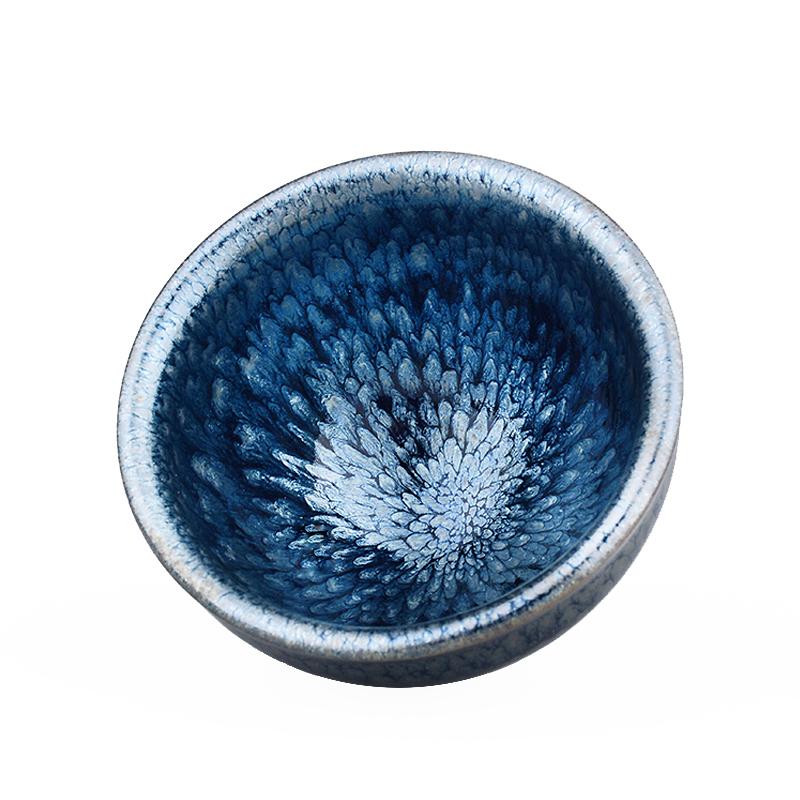
- Hare’s fur (nougime): Named for its resemblance to rabbit fur streaking downward, this glaze shows fine silvery or amber lines that trickle from the rim. It pairs beautifully with light oolongs and white teas, the subtle shimmer complementing delicate liquor colors.
- Oil spot (yohen): Circular iridescent spots create a dynamic, jewel-like interior. I find they enhance the visual pleasure of darker teas like pu’er or black teas, while also offering a tactile experience as the tiny crystals grip your lips.
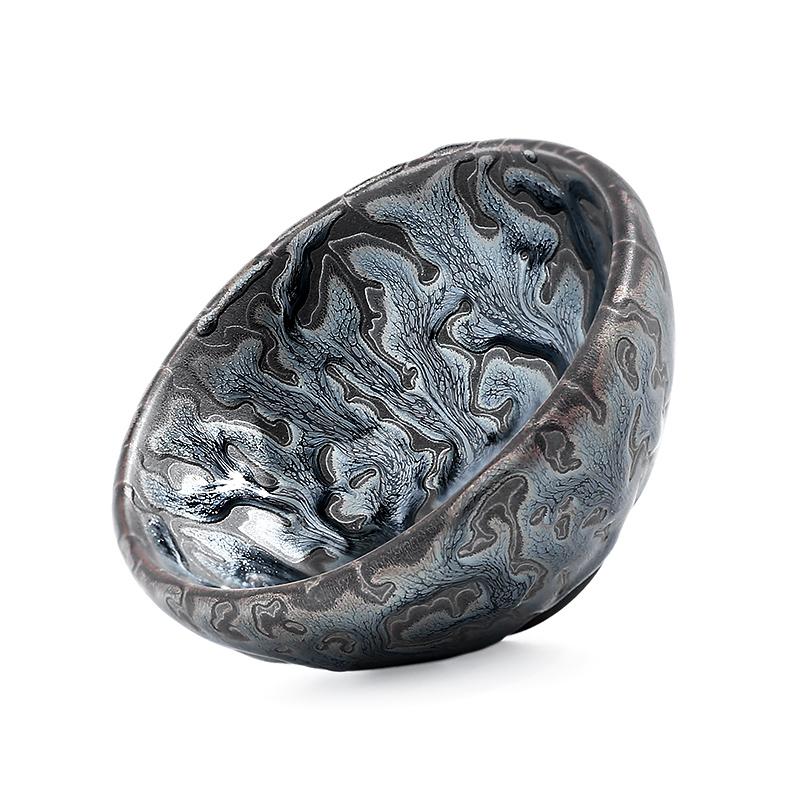
Both are equally traditional. The choice comes down to personality: hare’s fur is calligraphic and serene, oil spot is celestial and dramatic. My personal collection includes both, but for gongfu sessions with friends, I tend to reach for a hare’s fur tenmoku bowl—it’s an understated conversation starter. Browse our hare’s fur Jianzhan series to see the elegance firsthand.
Where to Find Authentic Tenmoku Tea Bowls for Sale
Now that you can separate real vs fake tenmoku, the next step is finding a trustworthy source. Avoid generic dropshipping platforms where “tenmoku” is a catch-all for cheap black cups. Instead, look for ceramic studios in Fujian or Kyoto that disclose the kiln, the clay source, and the artist’s name. Many modern masters like Chen Guowen or Yoshita Yukio create pieces with documented kiln logs. Direct from the artisan, a quality handmade tenmoku tea cup will run you $120–$350, and it’s worth every penny for the multi-generational artistry it carries.
If you’re just starting out, explore our handmade Jianzhan tea cups. We personally vet every piece for glaze authenticity and craftsmanship, and we offer a curated range from classic oil spot to contemporary interpretations. Every bowl comes with a card explaining kiln transformation details—exactly the kind of transparency that separates a treasure from an imitation.
Who Should Buy a Tenmoku Tea Bowl?
This guide has focused on identification, but let’s talk about you. I recommend a real tenmoku tea bowl to three types of people:
- The curious beginner who wants to elevate daily tea drinking with something handmade, not industrial. You’ll taste the difference a clay vessel makes.
- The premium lifestyle buyer looking for a meaningful gift for tea lovers. A tenmoku bowl is a piece of history; it outlasts any gadget.
- The collector or connoisseur who understands that an authentic jian zhan is the soul of the Japanese tea ceremony and Chinese gongfu tradition.
If you fall into any of these groups, investing in a true handmade ceramic tenmoku isn’t a purchase—it’s a relationship with a living craft.
Frequently Asked Questions About Tenmoku Tea Bowls
How can I tell if a tenmoku bowl is handmade?
Examine the foot (bottom rim). A handmade tenmoku tea bowl will have an unglazed, slightly irregular foot showing the dark iron-rich clay. Look for tool marks, the artist’s stamp, and subtle asymmetry. Machine-made fakes have a perfectly circular, often glazed, foot and white porcelain body.
What is the difference between oil spot and hare's fur patterns?
Oil spot (yohen) forms as circular crystalline rings of iron oxide that look like floating silver bubbles. Hare’s fur (nougime) appears as long, streaking lines reminiscent of rabbit fur. Both are Song Dynasty glaze effects, but oil spot tends to be more dramatic and iridescent, while hare’s fur is linear and elegant.
Are Japanese tenmoku bowls the same as Chinese Jianzhan?
They share roots but diverged. Chinese Jianzhan is the original black-glazed stoneware from Fujian. Japanese tenmoku often refers to bowls made in Seto or Mino kilns inspired by Chinese imports. Today, both traditions produce authentic pieces, but the Japanese versions sometimes use slightly different clay bodies and modern electric-firing techniques. When you buy, ask whether the piece is wood-fired in a dragon kiln (more traditional) or electric-fired.
Why are authentic Jianzhan tea bowls so expensive?
The high failure rate is the main reason. A potter may fire 100 bowls in a wood kiln, but only 10–15 survive without cracking or glaze defects. The raw iron-rich clay, the complex reduction cooling curve, and the unpredictable kiln transformation make each successful piece a rare event. Hand-making, carving, and months of drying also add to the cost.
Can I use a tenmoku bowl for everyday tea drinking?
Absolutely. Authentic tenmoku bowls are food-safe, lead-free, and extremely durable. The unglazed foot will absorb a little tea over time, developing a patina that tea lovers cherish. Just avoid harsh detergents—rinse with hot water and let it air-dry, exactly as you would care for a yixing teapot.
Do all tenmoku bowls have an iron-rich glaze?
By definition, yes. The term “tenmoku” specifically describes a high-iron content slip or glaze that matures to a deep black and yields crystalline patterns. If the glaze is not iron-rich, it cannot produce authentic oil spot or hare’s fur effects; it would simply be a painted black bowl.
Caring for Your Artisan Tenmoku: A Note on Longevity
Now that you own a genuine bowl, preserve its beauty. The iron glazes are food-safe but can be reactive. After use, rinse with warm water, gently wipe the inner surface, and let it dry upside down. Never use soap, which can strip the subtle patina that builds over time. For oil spot tenmoku cup interiors, a soft cloth removes any tea stains without scratching the crystals. With a little care, your handmade tenmoku tea cup will develop a depth that improves every session.
Explore Our Collection
Ready to experience the world of tenmoku tea bowl? Browse our curated collection:
Disclaimer: This article is for informational purposes. Products and pricing subject to change.


Condividere:
Tenmoku Tea Bowl: Quiet Luxury for a Better Tea Ritual at Home