

Introduction: Why Glaze Type Is the Heart of a Jianzhan
If you've ever held a Jianzhan teacup — also called a Tenmoku tea bowl in Japan and the West — and felt the weight of it, noticed how light plays across its dark glaze surface, you already know: this is not just a teacup. It is a collision of chemistry, fire, and a thousand years of craft.
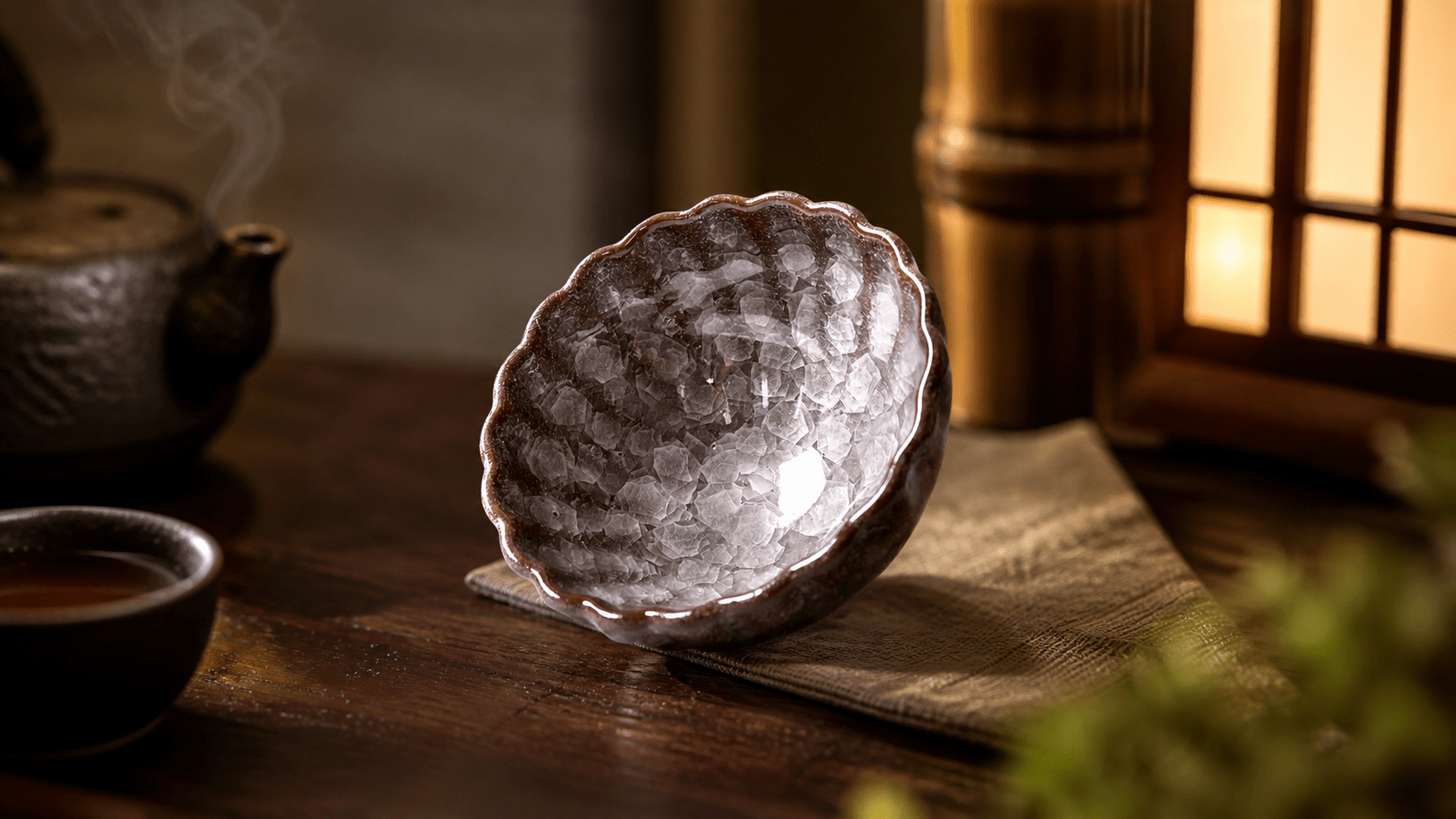
What makes each Jianzhan unmistakable is its glaze. The iron-rich mineral glaze applied thickly over the cup doesn't just sit there — it moves, it breathes, it transforms under extreme heat into patterns no human hand could draw: oil spots that shimmer like spilled gasoline in sunlight, hare's fur streaks that ripple downward like wind through grass, and the rarest of all — yohen (曜变), where colors seem to shift as you rotate the bowl.
Understanding these glaze types is the difference between buying a Jianzhan and knowing one. This guide covers everything you need to know about Jianzhan glaze types: how they're formed, what makes each type distinct, how to evaluate quality, and how to choose the right one for your tea practice.
What Is Jianzhan? A Quick Cultural Anchor
Jianzhan (建盏) is a black-glazed tea bowl produced in the Jianyang district of Nanping, Fujian Province, China. The kilns here — collectively called Jianyang kilns — flourished during the Song Dynasty (960–1279 AD) and produced what many consider the finest tea bowls in Chinese history.
The term Tenmoku is the Japanese reading, derived from Tianmu Mountain in Zhejiang Province, where Japanese Buddhist monks first encountered these bowls during the Song Dynasty and brought them home as treasured objects of the tea ceremony.
Jianzhan became inseparable from the doucha (斗茶) culture — competitive tea tasting where the frothy white matcha foam clashing against the deep black glaze created a visual spectacle prized by emperors, scholars, and monks alike. Even the Song Emperor Huizong wrote poetry about Jianzhan.
Today, Jianyang and Nanping remain the epicenter of authentic Jianzhan production. The craft was inscribed on China's National Intangible Cultural Heritage list in 2011 and granted National Geographic Indication Protection in 2016.
The Four Major Jianzhan Glaze Types
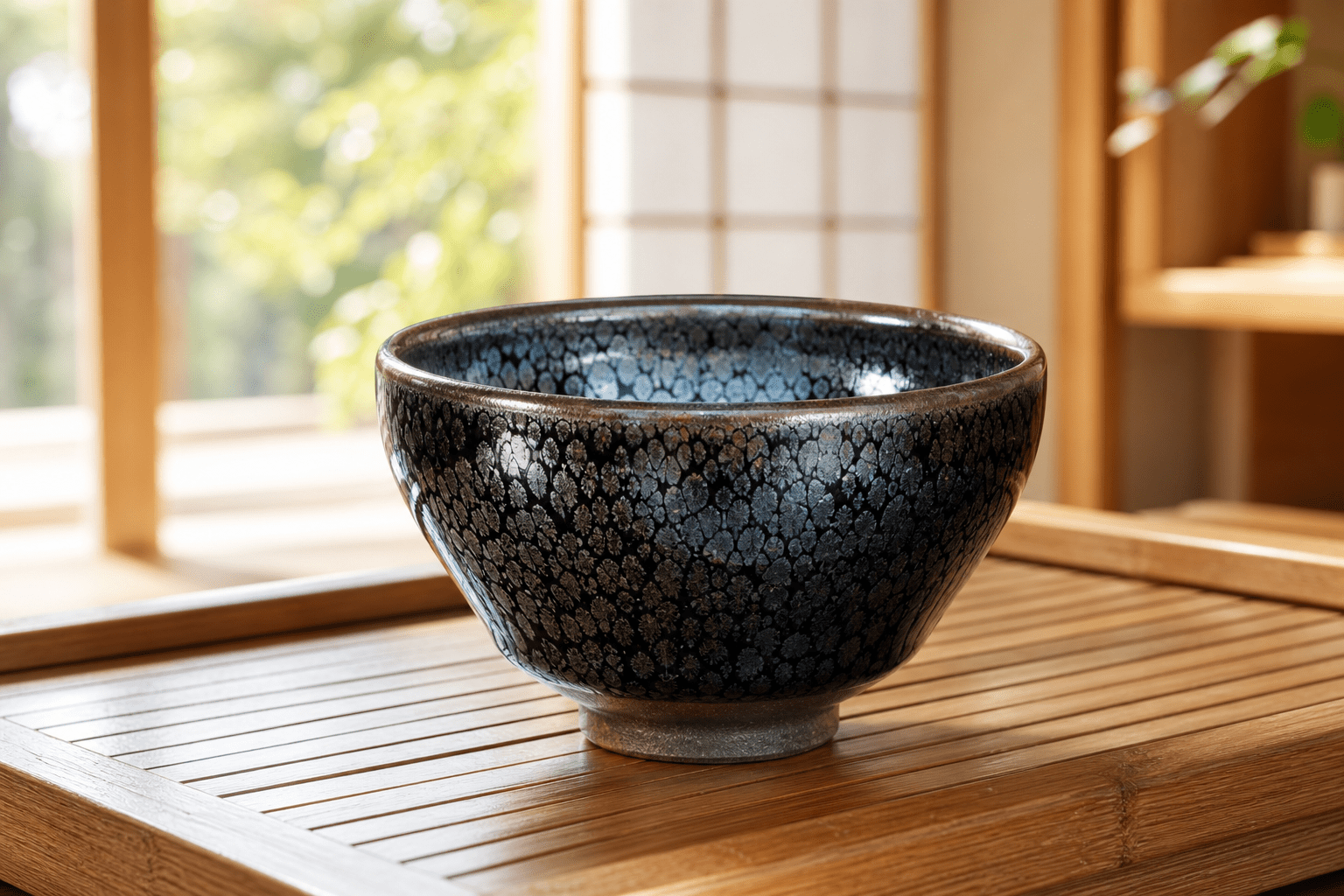
1. Oil Spot (油滴 / Yóu Dī) — The Most Recognizable
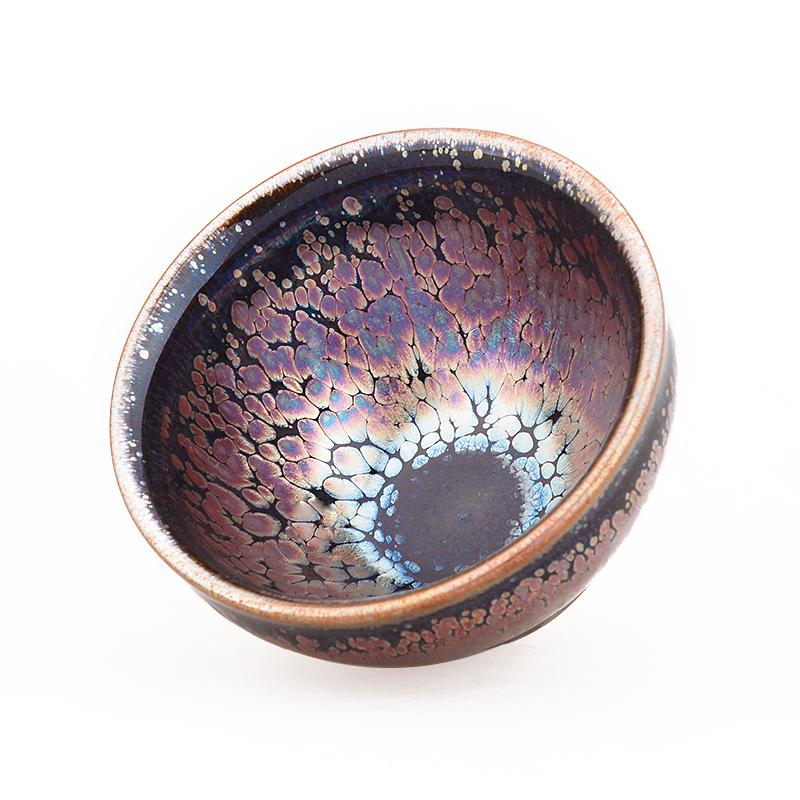
Appearance: Metallic or golden-bronze dots, lustrous and lens-like, scattered across a dark black or deep brown-black glaze surface. Under direct light, they appear to float above the glaze — an effect called crystal floating (晶体漂浮).
How it forms: During firing at approximately 1,230–1,300°C (cone 7–10), ferric iron oxide (Fe₂O₃) in the glaze loses its crystalline structure and converts to magnetite (Fe₃O₄), then to ferrous iron (FeO). As oxygen atoms are released, they bubble up through the viscous glaze — dragging magnetite particles with them. These particles deposit on the surface, forming metallic spots that re-oxidize slightly during cooling.
Condition for success: Glaze applied very thickly (6–10mm), carefully controlled kiln atmosphere — often oxidation with a reduction period — and controlled cooling to allow spots to develop without collapsing.
Cultural value: In 1511, Japanese records stated that Oil Spot bowls were valued at 5,000 bolts of silk — second only to Yohen. Among the 14 National Treasure-level ceramics designated by the Japanese government, 4 are Jianzhan bowls — 3 Yohen and 1 Oil Spot.
In your tea practice: Oil Spot cups are prized for how they enhance the visual experience of tea — particularly matcha or aged oolong — where the dark glaze makes the liquor color pop dramatically against the bowl interior.
Note for buyers: Not all modern oil spot cups achieve true metallic reflection. Some only show brownish matte spots. Look for metallic sheen under direct light. At Tenmokus, our Oil Spot series (such as the Oni Jianzhan) features genuine thermal-reduction-developed spots with clear metallic luster.
2. Hare's Fur (兔毫 / Tù Háo) — The Classic
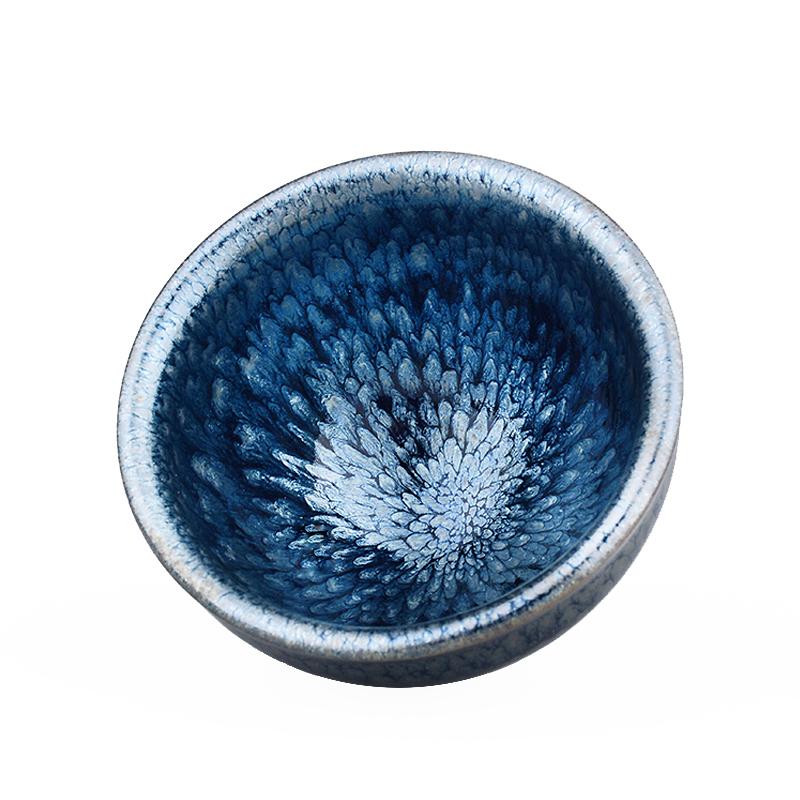
Appearance: Fine streaks — thin as a rabbit's whisker — radiating downward from rim to base. Golden-yellow to silvery-white against a deep black or brown-black ground. Subtle and understated — requires holding the bowl at an angle to fully appreciate.
How it forms: During firing, the thick iron glaze separates into two liquid phases — silica-rich and iron-rich — due to surface tension differences at high temperature. As the iron-rich phase stretches downward under gravity and cooling pulls it into thin filaments, these ribbons of iron oxide freeze in place as the glaze solidifies.
Cultural significance: Emperor Huizong's famous poem — "兔毫连盏烹云液,能解红颜入醉乡" (Hare's fur cups brew clouds and dew, enough to make beauties tipsy) — cemented the glaze type's status in Chinese literary history. Hare's Fur bowls were documented at 3,000 bolts of silk in the same 1511 Japanese records.
In your tea practice: Widely regarded as versatile. Ideal for focused tea drinking, contemplative practice, and everyday use. The understated aesthetic suits both Japanese wabi-sabi philosophy and Chinese literati tea tradition.
3. Yohen (曜变 / Shǎo Biàn) — The Rarest Art on Earth
Appearance: Appears black from a distance — but bring it into light and the glaze erupts with scattered spots of purple-blue, yellow, and orange, surrounded by iridescent halos that seem to glow from within. The spots shift in color as you rotate the bowl. No two Yohen bowls are alike.
How it forms: Yohen is the least understood and most difficult-to-replicate of all Jianzhan glazes. During the critical cooling window between 1,280°C and 1,050°C, a phase separation occurs in the iron-rich glaze, producing nanometer-scale crystals that create selective absorption — different wavelengths of light absorbed and reflected differently, producing shimmering rainbow halos. Partly controlled, partly serendipitous.
Historical context: Only three authenticated Song Dynasty Yohen bowls exist in the world, all in Japan. Considered the three most valuable tea bowls on earth, valued at 10,000 bolts of silk in 1511 records. The Yohen bowl at Tokyo's Shuko-in temple and the Nezu Museum are National Treasures of Japan.
2025 resonance: The "Purple Jade Heart — Chinese Jianzhan Culture Exhibition" was held at the National Museum of China in Beijing in early 2025. Contemporary masters Huang Meijin (British Museum collection) and Sun Jianxing (UNESCO certified) represent today's Yohen revival.
4. Partridge Spot (鹧鸪斑 / Zhè Gū Bān) — The Underrated Gem
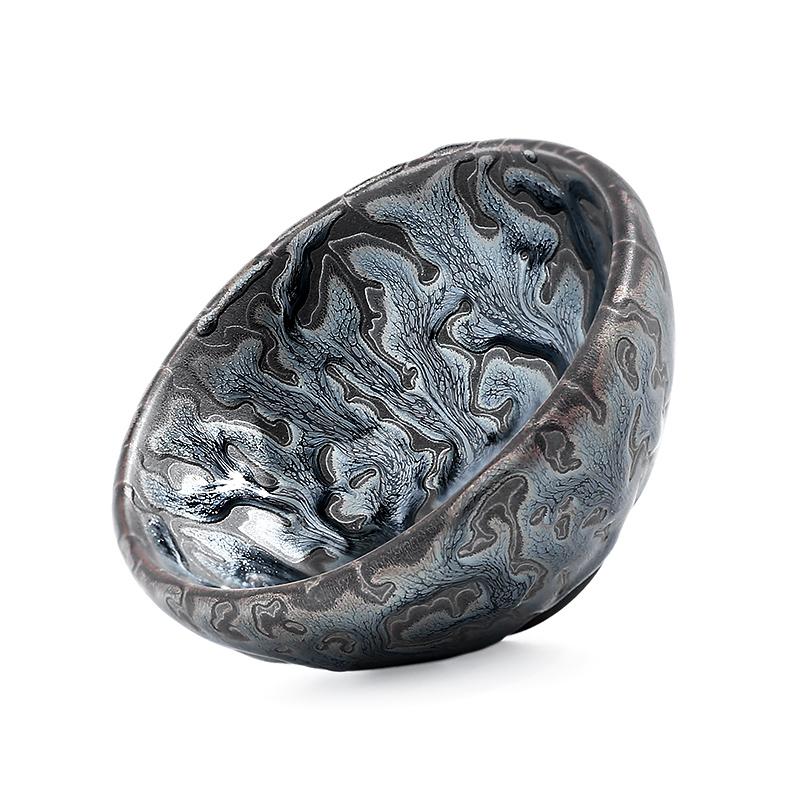
Appearance: Larger, irregularly shaped patches that resemble the speckled plumage of the Chinese partridge (zhègū). Rust-brown, copper-red, or cream-white against a dark ground. Can be scattered loosely or densely across the bowl interior.
How it forms: Iron-rich glaze pools in specific areas during cooling, forming large irregular accumulations of ferrous material. Unlike oil spots (rising bubbles) or hare's fur (gravity-driven streaking), Partridge Spot is primarily influenced by glaze thickness variation and localized temperature differences in the kiln.
In your tea practice: Offers a middle ground — visually striking enough to impress guests, with depth and texture to reward long use. Excellent display pieces as well as daily tea bowls.
Firing Methods: How Technique Shapes the Glaze
The glaze type is only half the story. How the cup is fired determines whether a given design reaches its full potential.
| Method | Description | Glaze Character |
|---|---|---|
| Wood-firing (柴烧) | Traditional dragon kiln, wood-fueled | Most variable, richest texture, natural ash deposits. Consumes 11 tons of wood per firing. |
| Gas-firing (气烧) | Modern kiln, precise temperature control | Consistent, cleaner釉面, less natural variation. |
| Hybrid (柴气) | Gas-assisted wood kiln | Modern innovation — gas to 1,000°C, then wood. Uses only 200–300 jin of wood vs. 11 tons traditional. |
| Electric (电烧) | Electric kiln | Most affordable, lowest variation. |
Choosing Your Jianzhan: Practical Guide
| Glaze Type | Best For |
|---|---|
| Oil Spot | Matcha, aged oolong, yancha, guests and display |
| Hare's Fur | All tea types, contemplative practice, everyday use |
| Yohen | Collectors, special occasions, display |
| Partridge Spot | Oolong, black tea, warm amber liquor teas |
Jianzhan and the World
Jianzhan's influence is measurable in museums, diplomatic gifts, and living tea culture on five continents. The British Museum, the Metropolitan Museum of Art (New York), Harvard Art Museums, and the Museum of East Asian Art in Cologne all hold Song Dynasty Jianzhan bowls.
In 1406, Ming Emperor Yongle gifted Jianzhan bowls to Japanese shogun Ashikaga Yoshimitsu. In 2017, an Oil Spot bowl was gifted to President Putin at the BRICS Summit. In 2024, the piece "Fortune and Prosperity Arrive Together" (福禄双至) was gifted as official diplomatic artwork at the Russia-China Commercial Forum.
Master Chen Dapeng's work was featured on Japanese NHK television. Sun Jianxing received UNESCO World Crafts Council certification. Huang Meijin's Gold Oil Spot bowl entered the British Museum collection.
Conclusion
Every Jianzhan is born from the same elemental drama — iron, fire, and the slow chemistry of cooling. A genuine Oil Spot bowl from Jianyang carries the weight of 1,000 years of craft and the specific fingerprint of the kiln it came from, the clay it was built on, the hands that shaped it.
Whether you're drawn to the metallic drama of Oil Spot, the quiet elegance of Hare's Fur, the mythical rarity of Yohen, or the painterly warmth of Partridge Spot — there is a Jianzhan that matches not just your tea, but the kind of moment you want tea to create.
Start with one. Hold it in your hands. Pour your tea. Watch what the light does.
Frequently Asked Questions
What makes Jianzhan different from other tea cups?
Jianzhan are made from iron-rich clay (8-12% Fe₂O₃) fired at temperatures exceeding 1300°C in Jianyang, Fujian. The spontaneous kiln transformation creates unique glaze patterns — oil spots, hare's fur, or partridge feathers — that cannot be replicated by machines. No two pieces are ever identical.
How do I care for my Jianzhan?
Clean with hot water only — never use dish soap as it strips the metallic sheen. Dry completely after washing. Store upside down. Avoid thermal shock (don't rinse hot bowls with cold water). With regular use, the glaze develops a beautiful patina called yang zhan.
What tea should I drink from a Jianzhan?
Jianzhan pairs exceptionally well with oolong teas and aged pu-erh. The dark glaze creates dramatic visual contrast with the tea liquor. The iron-rich clay also retains heat well, keeping tea warm longer during extended sessions.
Are all Jianzhan on the market authentic?
Unfortunately, no. The surge in Jianzhan popularity has brought many mass-produced counterfeits, often selling for under $30. Authentic Jianzhan require skilled artisans, traditional kilns, and weeks of labor. Always buy from verified sellers with documented provenance.


Condividere:
Your Morning Tea Ritual: Building a Mindful Practice with Jianzhan
How to Identify Authentic Handmade Jian Zhan: 5 Key Details to Check