

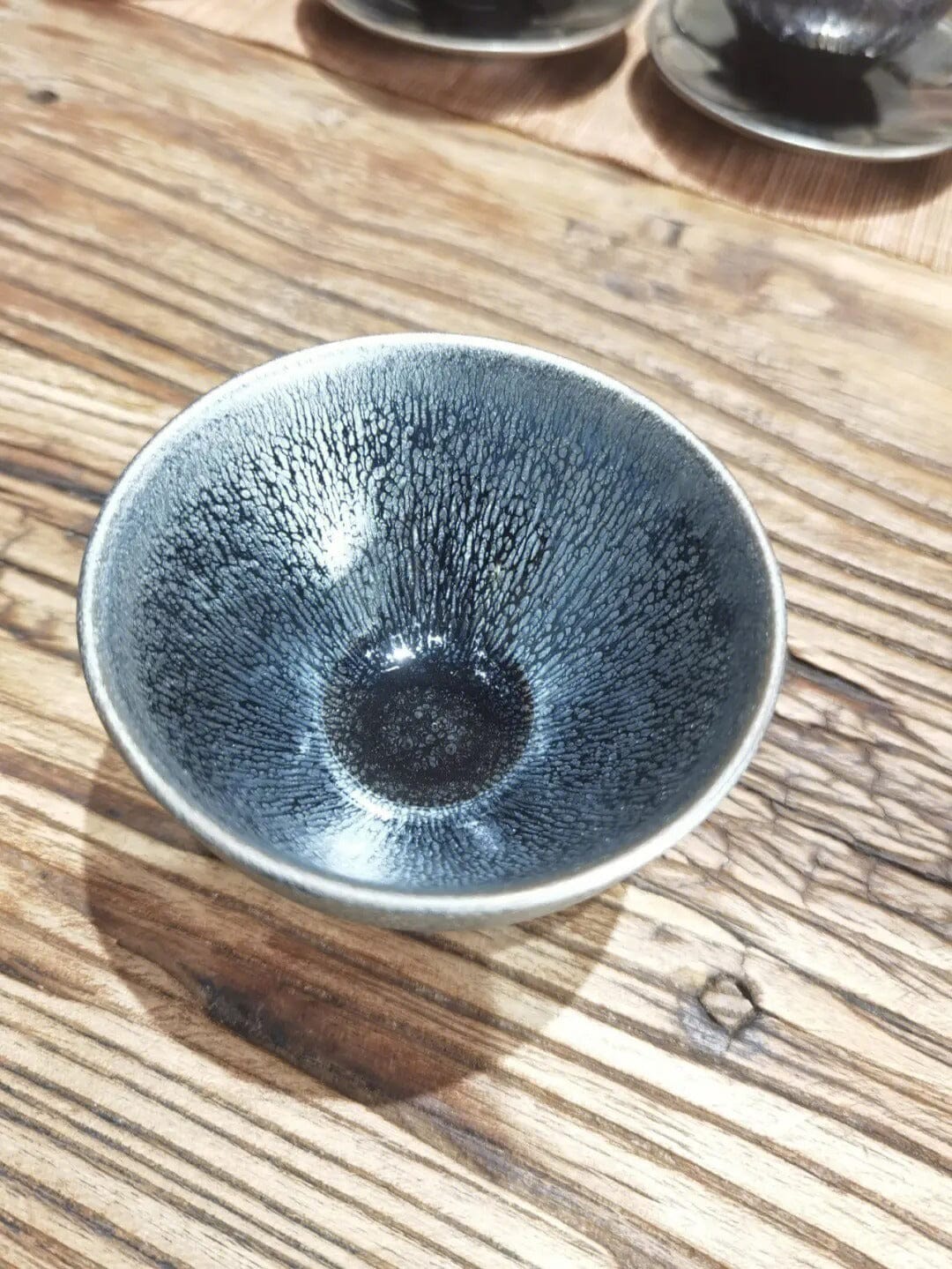
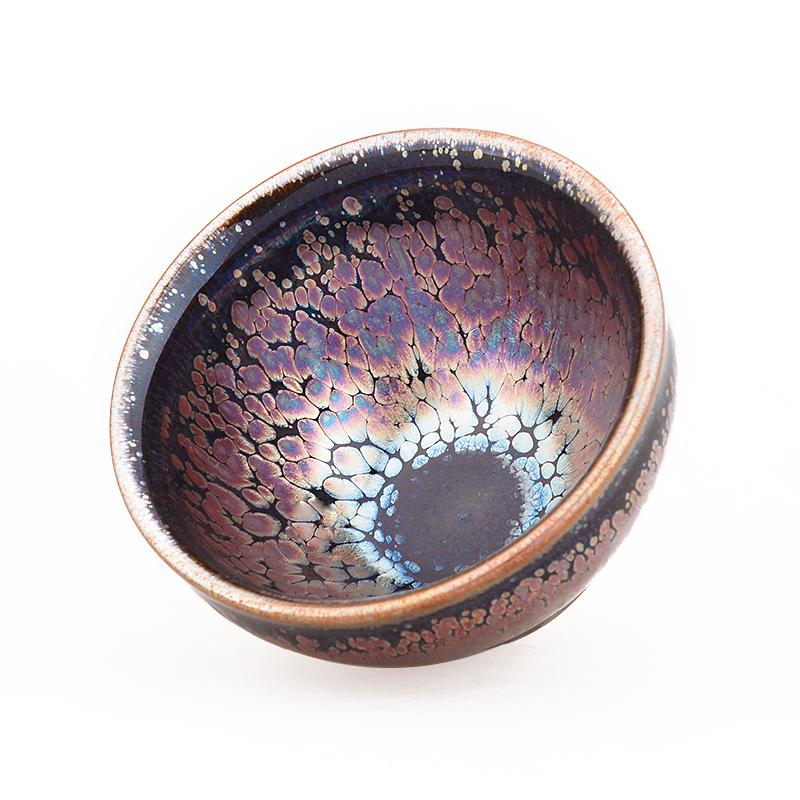
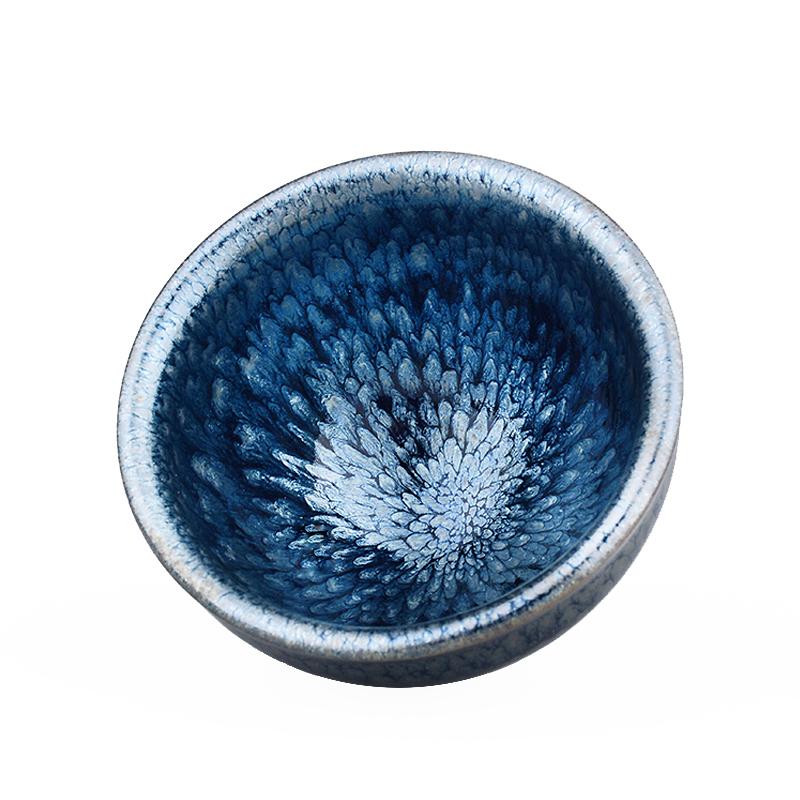
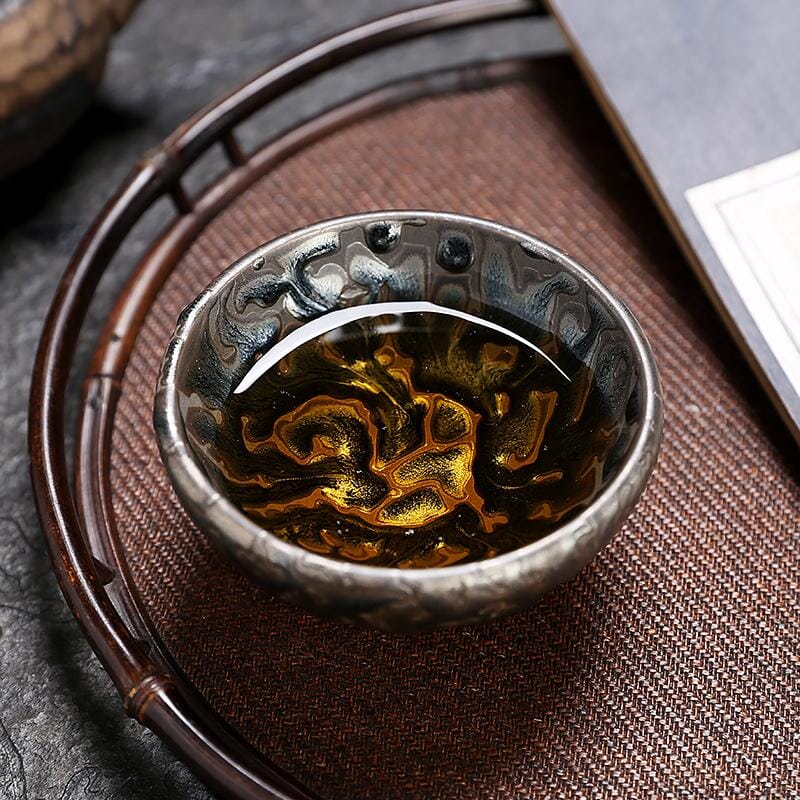
Among the magical patterns of Tenmoku, the beautiful "rabbit hair" Tenmoku is also a rare treasure, especially the "silver rabbit hair" Tenmoku. It has a strong metallic texture and a strong sense of relief when touched. It shines brightly under the light.
The beautiful and gentle image is like a beauty in the mirror, although difficult to touch, it is still pleasing to the eye and has a unique aesthetic interest. It is beautiful and ancient. Now, the author will unveil the mystery of the "silver rabbit hair" Tenmoku.
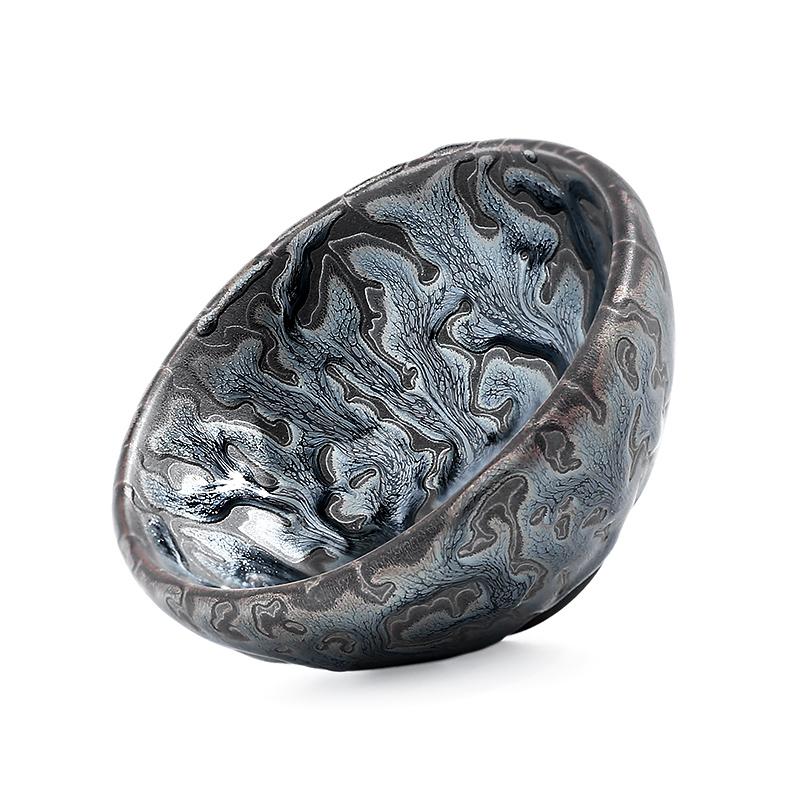
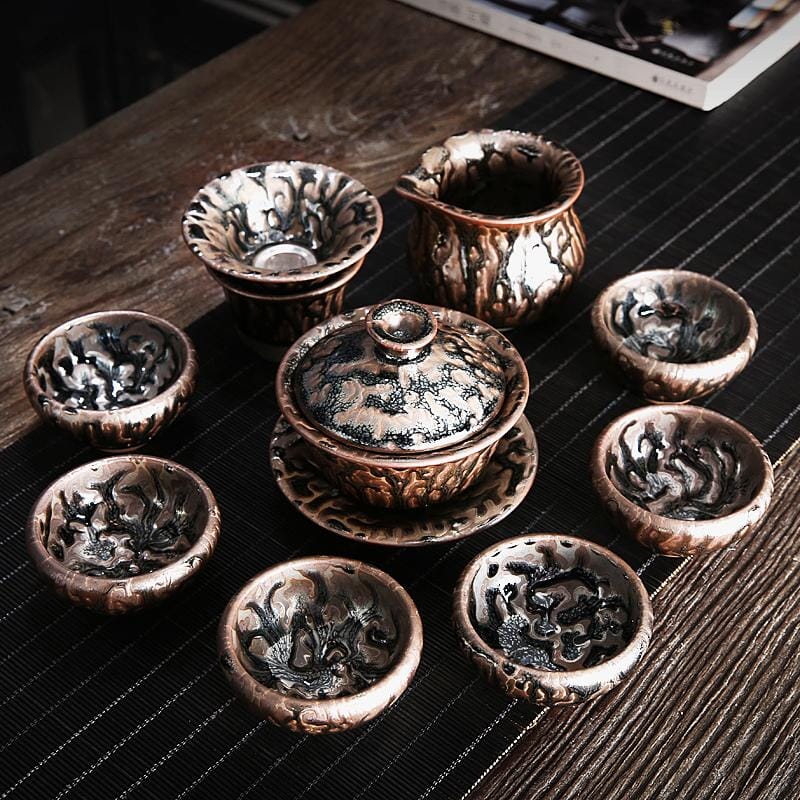
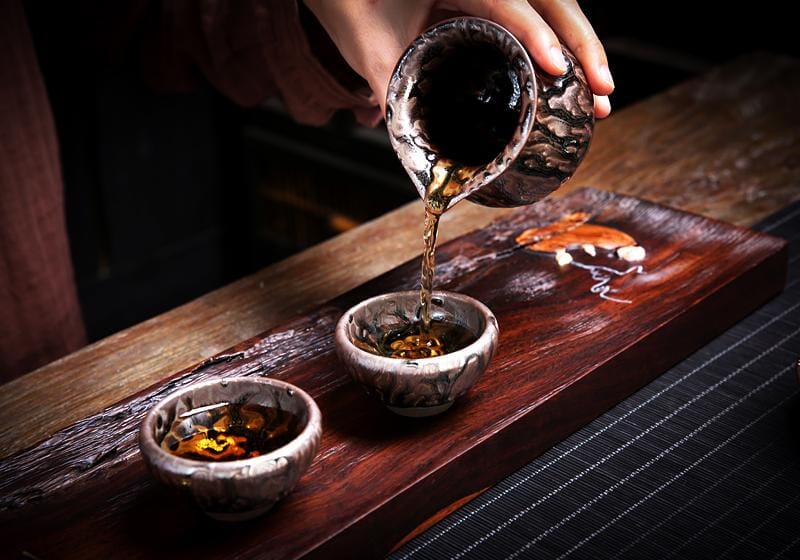
"Silver rabbit hair" Tenmoku with wooden texture.
Speaking of "rabbit hair" Tenmoku, we can start with the standard set by Emperor Huizong of the Song Dynasty: the color of the Tenmoku should be valued for its dark green, and the quality of the "jade hair" should be the best. Although the production of "rabbit hair" Tenmoku is higher than other patterns, it is not easy to produce a Tenmoku that meets Emperor Huizong's standards. To understand Emperor Huizong's standard, we can interpret it as follows: "The 'rabbit hair' should be 'reached', with a well-proportioned density, clear boundaries, and a sense of hierarchy."
The "rabbit hair" has differences in length, thickness, and color, such as gold and silver. We should be aware that if the Tenmoku firing process is unstable, it is difficult to produce this type of crystal. Therefore, the silver pattern is more precious than the brown pattern, and it is even rarer if the silver has a blue light.
So, let's summarize the conditions that a top-quality "rabbit hair" Tenmoku needs to meet: "The 'rabbit hair' should be well-proportioned in density, with clear boundaries, a three-dimensional effect, and a silver-blue color. In the same Tenmoku, the "rabbit hair" pattern may be clear in some places, blurry in others, or even show different colors in different places. The pattern may also have unique transitions, making it more layered and three-dimensional."
Is it difficult to fire Tenmoku with silver patterns?
As mentioned earlier, the silver pattern in "rabbit hair" Tenmoku is the most precious and also more difficult to fire.
Tenmoku glaze belongs to the iron crystal glaze. The material of the crystal (i.e., the pattern) is the oxide of iron. Among the iron oxide, there are divalent iron and trivalent iron. Divalent iron is a strong solvent and easily melts into the glaze. It can be said that the content of divalent iron directly affects the color and shape of the pattern. It is due to the presence of divalent iron that the crystalline material is very unstable.
So, why is it difficult to fire silver patterns?
The key point of this issue is the reduction atmosphere. Here is a common sense: "The 'rabbit hair,' 'oil spot,' and 'transmutation' patterns need to be formed in a reduction atmosphere, and there are few patterns on the glaze surface in an oxidizing atmosphere." This indicates that the material that forms the pattern must be produced in a reduction atmosphere.
Is it easier to fire brown patterns than silver patterns? The answer is yes. This is because the material that forms brown patterns is mainly trivalent iron, and a reduction atmosphere is needed in the early stage of firing to control the pattern's shape. Later, an oxidizing atmosphere can be used to control the color of the pattern.
Compared to the reduction atmosphere, the oxidizing atmosphere is much easier to control. Therefore, the control of the shape and color of brown patterns is relatively stable.
For silver patterns, a reduction atmosphere is needed in the early stage of firing to reduce trivalent iron to divalent iron. However, reduction needs to continue in the later stage, and this is where the problem arises: if reduction is not enough at this point and trivalent iron is too high, the pattern appears gray, and there is a dirty feeling on the surface of the pattern. On the other hand, if reduction is excessive and divalent iron is too high, the pattern will become lighter or even disappear. Therefore, it is very difficult to control this degree, making firing silver patterns very unstable.
Now you know, firing silver patterns is not only difficult to stabilize the color, but also very difficult to control the shape, depth, clarity, and so on of the pattern.
If the dynamic point that forms the pattern happens to be captured, its shape can be preserved. However, the pattern during firing is too deeply hidden and changes too quickly, and most silver "rabbit hair" patterns disappear before they can even be captured, as if they never existed. This precious "silver rabbit hair" is highly sought after in the Tenmoku market and is worth acquiring.


Share:
I didn't expect that Tenmoku kiln also fired these interesting things!
Jianzhan Tenmoku Crackles: Glaze Lines or Damage?