

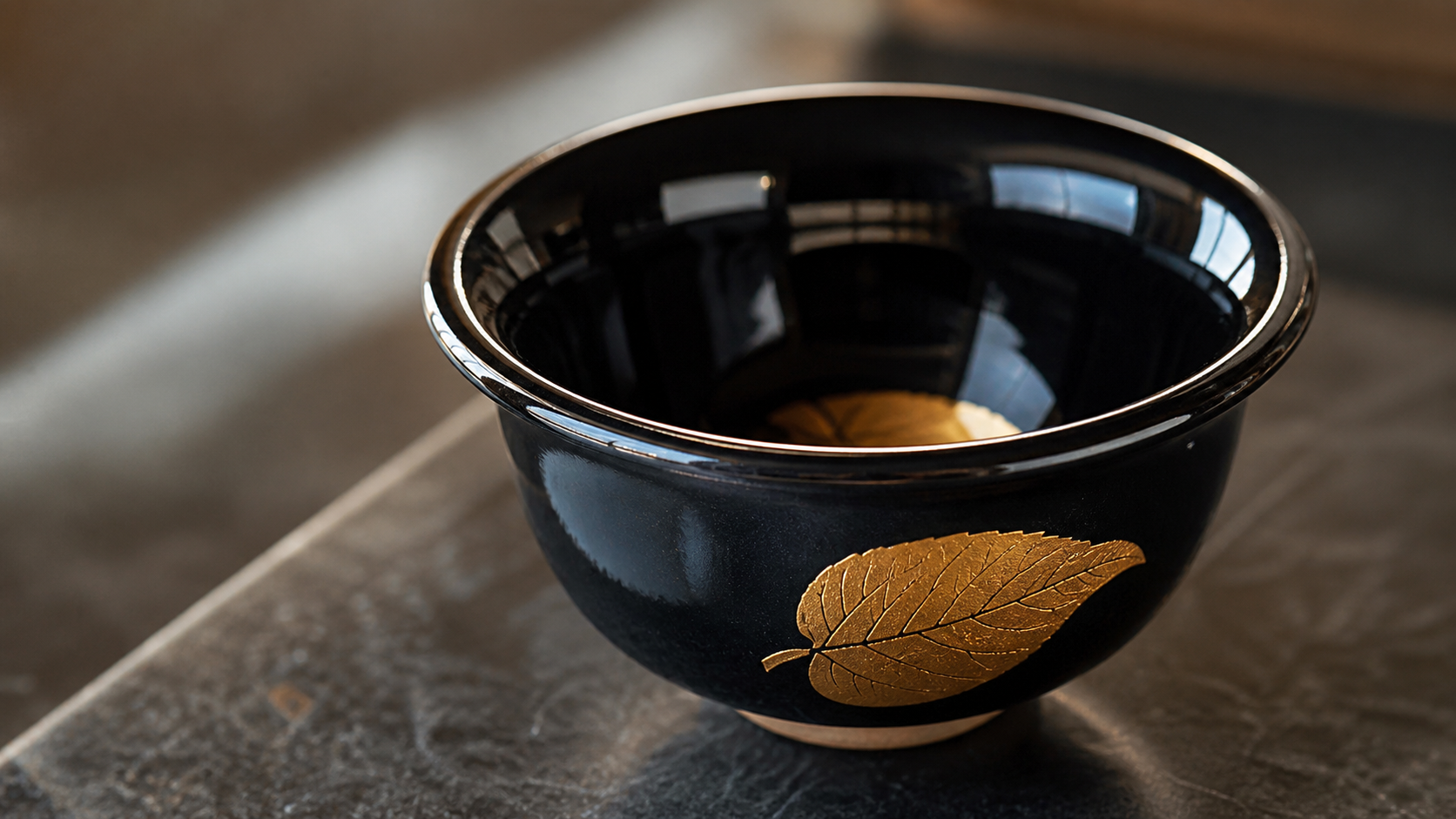

Tenmoku Tea Bowl Authenticity Guide: Choose a Better Cup for Gongfu Tea
A real tenmoku tea bowl is more than a dark cup with shiny speckles: it is a high-fired ceramic piece whose clay, iron-rich glaze, and kiln atmosphere work together. If you are choosing a bowl for gongfu tea, oolong tea, or a meaningful gift for tea lovers, the most reliable approach is to evaluate the whole object—not just a dramatic rainbow photo.
Many products are inspired by Tenmoku and can still be enjoyable to use. The issue begins when a factory-made imitation, printed surface, or vaguely described Japanese tea bowl is presented as an authentic Jianzhan. This guide explains what to look for, what questions to ask, and where uncertainty is normal.
Key Takeaways
- An authentic Jianzhan is traditionally associated with Jianyang, Fujian, China, and made with high-iron clay and glaze.
- Oil-spot and hare’s-fur effects should appear integrated into the glaze, not like a flat metallic print sitting on top.
- Handmade does not mean flawless. Small variations in shape, glaze flow, and foot finishing can be normal.
- A single photo, a magnet test, or a high price cannot prove authenticity by itself.
- The best purchase is one with clear origin, material/process information, honest photos, and a seller willing to answer specific questions.
What does real vs fake tenmoku actually mean?
“Fake” can mean several different things, so it helps to be precise. A modern bowl may be genuinely handmade and beautiful while not being a traditional Jianzhan from Jianyang. A Japanese Tenmoku-style bowl may also be a legitimate Japanese tea bowl, but it should not automatically be marketed as Jianzhan.
In the strictest sense, Jianzhan refers to black-glazed tea bowls linked to the historic kiln tradition of Jianyang in Fujian. Their recognizable surface effects come from an iron-rich glaze exposed to demanding firing conditions. During firing and cooling, iron compounds can form patterns such as hare’s fur, oil spot, or other shifting crystalline effects.
For a buyer, real vs fake tenmoku is therefore less about finding one magical visual trait and more about matching the seller’s claim to the actual object. If a listing says “handmade Jianzhan from Fujian,” it should provide more than generic phrases such as “ancient craftsmanship” or “museum quality.”
| Claim or feature | What supports confidence | What deserves caution |
|---|---|---|
| Origin | Specific reference to Jianyang, Fujian, workshop, or maker when available | Only says “Asian style” or uses origin terms without details |
| Glaze | Depth, variation, and patterns that remain part of the surface under different light | Repeated identical pattern, flat-looking graphic, or paint-like metallic layer |
| Form | Subtle asymmetry and hand-finished foot appropriate to handmade work | Perfectly uniform pieces sold as individually hand-thrown without evidence |
| Product information | Clear dimensions, care guidance, process notes, and original photos | Only glamour images, vague claims, or contradictory descriptions |
| Price | Explained by craftsmanship, finish, provenance, and seller service | Price used as the only proof of authenticity |
How do you identify real Jianzhan without becoming a ceramics expert?
You do not need to be a collector to make a thoughtful choice. Start by assessing three connected areas: the clay body, the glaze, and the seller’s transparency. Think of it like buying a handmade leather bag: stitching matters, but so do the material, construction, and the maker standing behind the product.
1. Look beneath the rim
Turn the bowl over. Traditional-style Jianzhan often has a darker, dense-looking body associated with iron-bearing local clay. The unglazed foot may feel hand-finished rather than mechanically identical from piece to piece. It should be smooth enough for practical use, but it may retain slight signs of trimming or firing.
Color alone is not proof. Different clays and firing conditions create variation, and photographs can distort color. Instead, look for whether the foot, body, and glaze description tell one coherent story.
2. Examine glaze depth in normal light
Real kiln effects usually have visual depth. Tilt the cup near a window or under a warm lamp. A well-developed glaze may shift from black to brown, blue, silver, or subtle bronze depending on the angle. The effect should feel embedded in glassy glaze rather than printed like foil on a phone case.
That does not mean every authentic piece must be highly iridescent. Some excellent bowls are quiet, dark, and understated. A flashy rainbow finish is not automatically better, older, or more authentic.
3. Expect individual variation
Handmade high-fire ceramics are shaped by variables that cannot be perfectly repeated: glaze thickness, placement in the kiln, heat flow, ash, reduction, and cooling. Two cups from the same workshop can be clearly related yet not identical.
When dozens of listings use precisely the same oil-spot image, ask whether the photo shows the actual bowl you will receive. For premium buyers and gift shoppers, receiving the exact photographed piece is a meaningful advantage.
4. Read the listing for useful specifics
A credible seller should be able to explain whether a bowl is handmade, where it was made, its approximate capacity, whether it is food-safe for normal tea use, and how it should be cared for. “Handmade” is a process claim, not a substitute for details.
Useful questions include: Was this bowl made in Jianyang, Fujian? Is the listed photo the exact piece? What glaze effect is being described? Is the bowl intended for tea, and what care is recommended? Direct answers are more valuable than overly romantic language.
What is the difference between Jianzhan oil spot vs fake oil spot?
Oil spot is one of the most searched—and most misunderstood—Jianzhan effects. In a genuine high-fired iron-rich glaze, spot-like effects arise through kiln chemistry. They can look like silver, blue, bronze, or multicolor dots, but their size, density, edge definition, and reflectivity vary naturally across a bowl.
In a suspected imitation, the pattern may appear too uniform, too sharply repeated, or disconnected from the glaze surface. Some decorative cups use decals, sprayed metallic finishes, or digital-looking patterns. These may look striking online, particularly under studio lighting, but the surface can appear flatter in person.
Use this practical inspection sequence:
- Change the light: view the bowl from several angles rather than trusting one product image.
- Check the pattern rhythm: natural kiln effects often cluster, thin out, or change near the rim and lower wall.
- Look for glaze integration: spots should read as part of the fired surface, not as a separate decorative coating.
- Compare the interior and exterior: a maker’s glazing approach should make visual sense across the whole bowl.
- Ask for current photos: a close-up in daylight can reveal more than heavily edited listing images.
There is an important limit: no online checklist can authenticate every bowl with certainty. A careful buyer avoids declaring a piece fake solely because it has a subtle pattern, a rough foot, or a low price. Instead, assess whether the evidence supports the exact claim being made.
Are Japanese Tenmoku bowls the same as authentic Jianzhan?
They are related through tea culture and ceramic history, but they are not interchangeable labels. “Tenmoku” is the Japanese reading associated with a Chinese term connected to black-glazed tea bowls. Japan adopted and developed its own tea-bowl traditions, including forms valued in chanoyu and other Japanese tea practices.
A Japanese Tenmoku-style bowl can be a legitimate, carefully made Japanese tea bowl. It may have a different clay body, firing method, silhouette, and cultural context than a Jianzhan from Fujian. Calling every dark-glazed bowl “Jianzhan” erases those differences and makes shopping less clear.
If you are searching for japanese tenmoku for sale, decide what you actually want: a Japanese-made bowl, a bowl inspired by Japanese tea aesthetics, or a Jianyang-made Jianzhan. Each can be worthwhile, but the product page should identify it honestly.
For gongfu tea, the choice is personal. A smaller Jianzhan cup can frame the aroma and color of oolong tea beautifully, while a wider Japanese tea bowl may invite a slower, more contemplative session. Neither is universally “better”; the right cup matches your tea habit, hand feel, and collecting interest.
Which process markers matter when buying a tenmoku tea bowl for sale?
Buyers often focus on the dramatic glaze and overlook the making process. That is understandable—the surface is captivating—but process markers provide the context that helps you shop wisely.
Traditional Jianzhan-style work depends on materials and firing, not simply a black coating. The bowl is formed, dried, glazed, and fired at high temperature. The iron-rich glaze is central to the final appearance, while the kiln environment influences whether a surface develops visible streaks, spots, or a more restrained black finish.
Process evidence may include workshop information, photos of individual pieces, firing notes, maker attribution, and a realistic explanation of variation. None of these alone is a certificate of authenticity, but together they create a more trustworthy picture.
Be cautious with these common signals:
- “Ancient” used for a new cup: a newly made bowl can be authentic contemporary Jianzhan, but it is not automatically an antique.
- “Collector grade” without details: ask what standards or provenance support the phrase.
- Impossible perfection: handmade ceramic work can be refined without being identical from cup to cup.
- Health or tea claims: avoid sellers who promise that a cup cures problems or transforms water in guaranteed ways.
- Unclear photos: if you cannot see the foot, rim, interior, and glaze up close, request more images before buying.
For a gift for tea lovers, clarity is often more valuable than hype. A card describing the bowl’s actual origin, process, and care can make the gift feel personal and considered.
How should beginners choose the best Jianzhan tea cup for daily use?
The best Jianzhan tea cup is the one you will actually reach for. Start with size and comfort before pursuing the rarest-looking glaze. For gongfu tea, many drinkers prefer a compact cup that holds a small pour comfortably and lets them notice aroma, temperature, and color.
Choose a rim that feels comfortable against your lips, a foot that sits steadily, and a bowl shape that is easy to hold. If you regularly brew roasted oolong tea, a dark interior can make the tea’s amber color feel especially warm and focused. If you drink lighter teas, consider whether you prefer a more open bowl that makes color easier to see.
When evaluating a tenmoku tea bowl for sale, use this buyer checklist:
- Confirm whether the image shows the exact piece.
- Check capacity in ounces or milliliters.
- Review the stated origin and maker/workshop details.
- Look for close-ups of rim, interior, exterior, and foot.
- Read care instructions, return terms, and shipping information.
- Choose a glaze you enjoy in ordinary light, not only in dramatic product photography.
Shop authentic Tenmoku tea bowls when you are ready to compare individual pieces with clear details. You can also Explore our handmade Jianzhan tea cups to find a daily companion or a gift-worthy bowl.
FAQ: Real vs Fake Tenmoku Tea Bowls
How can I identify real Jianzhan from photos?
Look for multiple unfiltered views of the actual piece, including the foot, rim, interior, and exterior. Confirm origin information, ask whether the bowl is individually photographed, and look for a glaze with depth rather than a repeated graphic pattern. Photos alone cannot provide absolute proof, so seller transparency matters.
Is every dark Japanese tea bowl an authentic Jianzhan?
No. A Japanese tea bowl may be authentically Japanese-made and still not be Jianzhan. Jianzhan refers to a specific Chinese black-glaze tradition associated with Jianyang, Fujian. Respecting the distinction helps you buy the style and origin you intend.
What should Jianzhan oil spot vs fake oil spot look like?
Authentic-looking oil-spot effects generally appear integrated into the fired glaze and change with light and angle. Suspect patterns often look flat, overly identical, or like a metallic decorative layer. However, variation is broad, so use origin and process information alongside visual inspection.
Does an authentic Jianzhan need to have rainbow colors?
No. Many authentic Jianzhan pieces are mostly black, brown-black, or subtly reflective. Strong iridescence can be beautiful, but it is not a universal marker of quality or authenticity.
Are handmade cups always irregular?
Not necessarily. Skilled makers can produce refined, balanced forms. Handmade work often shows small variations in silhouette, trimming, glaze flow, or pattern, but those details should be evaluated in context rather than treated as defects.
Is a cheap tenmoku tea bowl always fake?
No. Price is not conclusive. Lower cost can reflect production scale, materials, a simpler glaze, or a sale. The key question is whether the listing accurately describes what you are buying and supports claims about origin and handcraft.
Can I use an authentic Jianzhan for gongfu tea every day?
Generally, a properly made tea bowl intended for beverage use can be enjoyed daily for gongfu tea. Follow the seller’s care instructions, avoid sudden temperature shocks, and inspect for damage before use. If you have a specific food-safety question, ask the seller directly.
Choose evidence, not just a dazzling glaze
A tenmoku tea bowl becomes more meaningful when you understand what you are holding: a fired object shaped by clay, glaze, heat, and a living tea tradition. The most confident answer to real vs fake tenmoku is not a single visual trick. It is a consistent combination of provenance, process, craftsmanship, and honest presentation.
Whether you are building a gongfu tea ritual, choosing a distinctive gift for tea lovers, or looking for your first authentic Jianzhan, buy the piece whose story is as clear as its surface is compelling. A good bowl should invite you to slow down, brew tea, and enjoy it—not leave you guessing what it really is.


Explore Our Collection
Ready to experience the world of tenmoku tea bowl? Browse our curated collection:
Disclaimer: This article is for informational purposes. Products and pricing subject to change.
Compartir:
How to Choose a Handmade Tenmoku Tea Bowl for Gongfu Tea (And Avoid Fake Jian Zhan)