

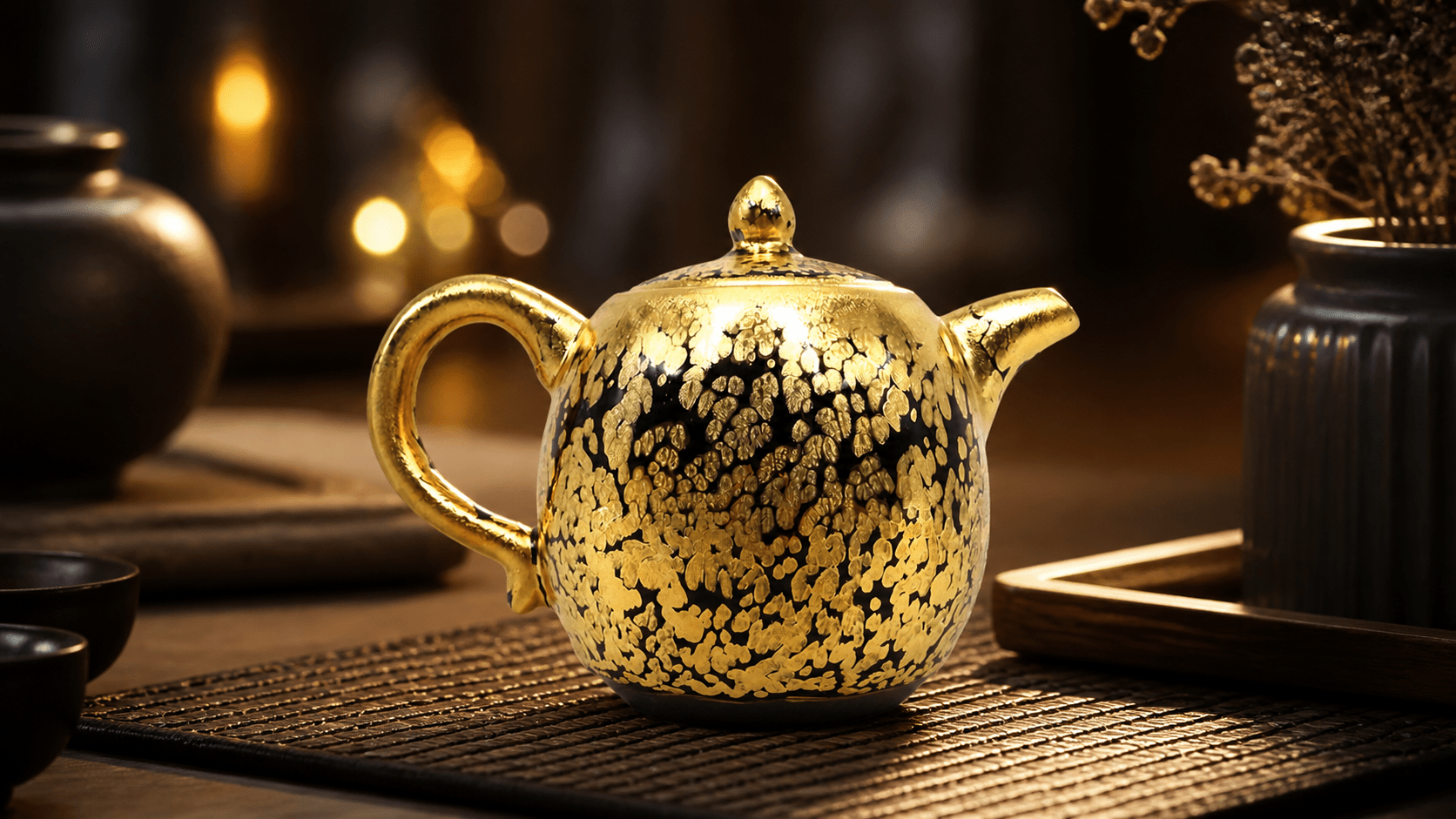

Key Takeaways: Why Tenmoku Tea Bowls Cost So Much
- Every genuine tenmoku tea bowl is handmade through a 12+ step, weeks-long process that has barely changed since the Song Dynasty.
- The signature oil spot and hare's fur patterns emerge randomly inside a 1300°C kiln—only about 1 in 10 emerges flawless.
- Authentic jian zhan requires unique clay and mineral glazes from Jianyang, China, a resource that cannot be replicated elsewhere.
- The bowl enhances gongfu tea by softening water, preserving heat, and turning a simple drink into a visual meditation.
- A fair tenmoku tea bowl price covers not just labor, but the artist’s years of training and the silent value of a kiln change that will never repeat.
Hey, I’m Tenmokus Editorial Team. If you’ve ever daydreamed over a tenmoku tea bowl and then flinched at the price tag, you’re not alone. When I began my journey with gongfu tea, I couldn’t understand why a simple-looking black cup could cost as much as a fine bottle of whiskey. But after visiting the ancient kilns in Jianyang and getting my hands dirty with local potters, the mystery dissolved. A tenmoku tea bowl isn’t a mass-produced mug—it’s a time capsule of fire, geology, and pure chance. In this article, I’ll walk you through every reason these bowls command their price, and I’ll help you find one that’s worth every cent.
What Makes a Handmade Tenmoku Tea Cup So Labor-Intensive?
Americans know that a hand-stitched leather bag costs more than a factory one. The same principle applies here, but with even higher stakes. A true handmade tenmoku tea cup goes through a dozen stages, each requiring obsessive attention.
The process starts in a small Jianyang workshop. The potter blends local clay rich in iron and trace minerals. This iron is what gives the finished bowl its deep black color and acts as a canvas for the glaze patterns. The body is thrown on a wheel, trimmed to the perfect lotus or conical shape, and set to dry for days. If the clay warps during this patient drying, the whole piece is trashed before it ever sees a kiln.
Then comes bisque firing—a gentle first burn to harden the body. After cooling, the artist applies the tenmoku glaze, a secret recipe that has been passed down for centuries. This isn’t paint; it’s a thick liquid suspension of local feldspar, limestone, and wood ash. Getting the thickness right is a knife-edge skill. Too thin, and you get a boring uniform brown. Too thick, and the glaze will run off the bowl during firing, fusing it to the sagger and destroying the piece.
The firing itself is a marathon. The bowls are stacked inside saggers in a dragon kiln that climbs up a hillside. Temperatures surge to over 1300°C (2372°F) for 20 hours or more, often stoked with pine wood that adds its own volatile chemistry to the kiln atmosphere. The craftsman can’t see inside—they rely on sound, smell, and droplets of slumped glaze to guess when the moment of truth has arrived. This labor intensity alone explains a large part of the jian zhan cost; one kiln firing often yields more shattered saggers than salable bowls.
Why Tenmoku Glaze Is a Million-Dollar Gamble
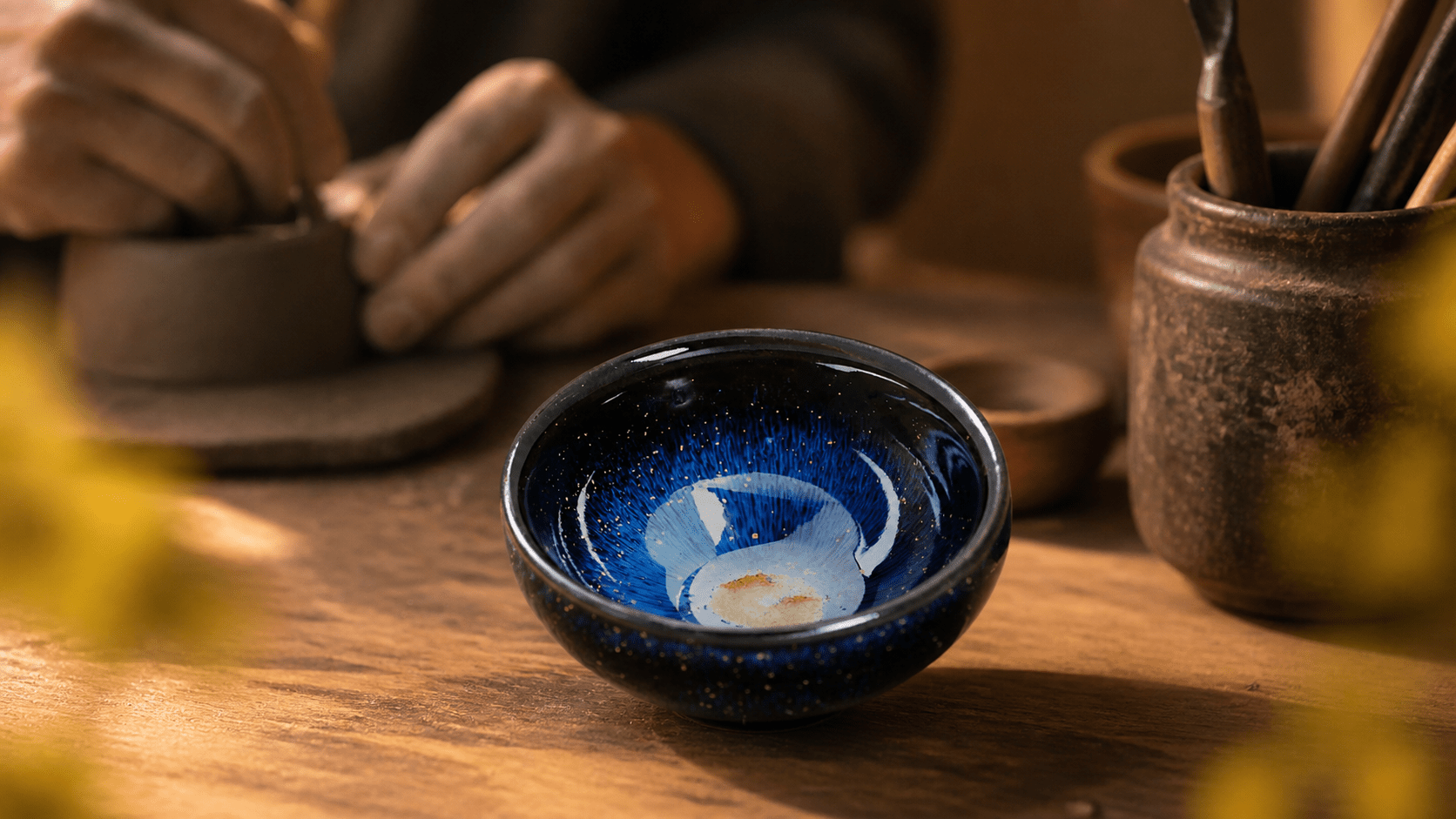
Here’s where the real magic—and the heartbreak—lies. What collectors obsess over isn’t just the deep black background, but the “oil spot” or “hare’s fur” crystals that bloom inside the glaze. This phenomenon is called kiln change, or yohen in Japanese, a term of such reverence that Japan designated some masterpieces National Treasures.
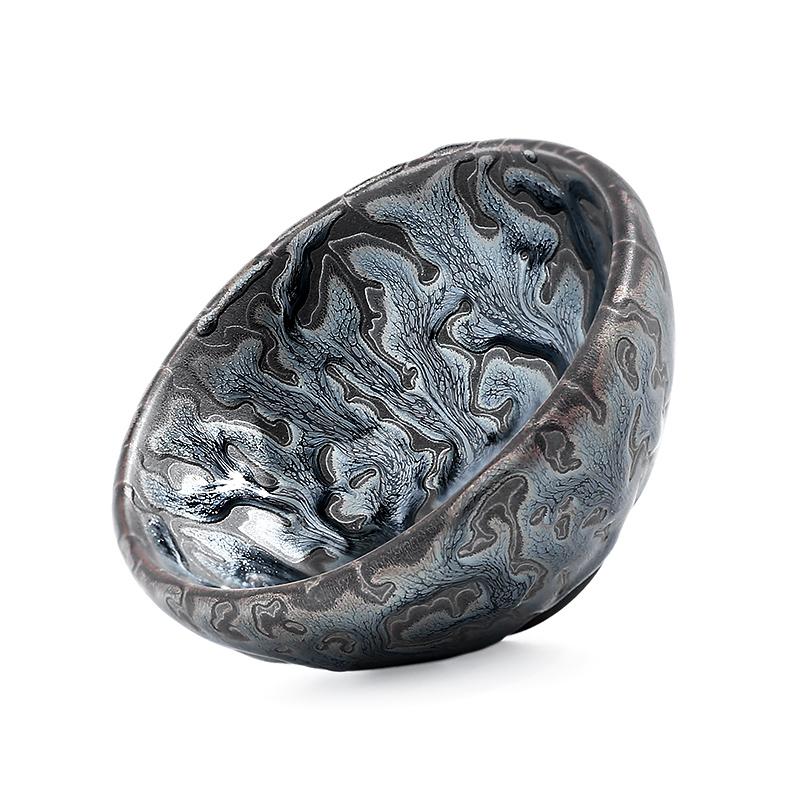
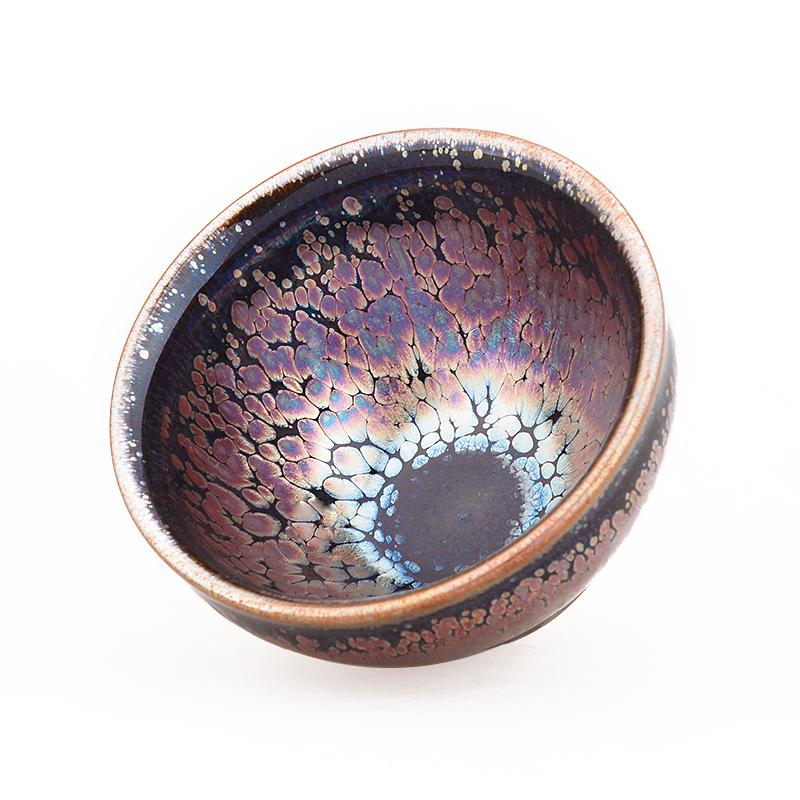
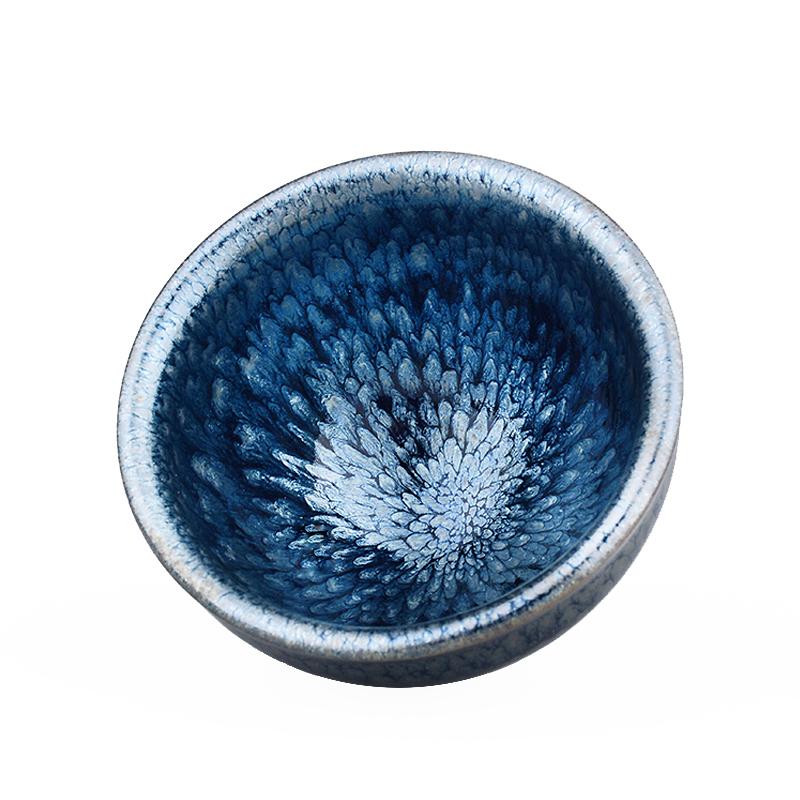
During the peak heat, the thick iron glaze melts into a liquid glass. As it slowly cools, iron oxide separates from the silica, forming droplets that rise to the surface. In an oil spot tenmoku cup, these droplets crystallize into metallic silver rings that look like floating epaulets of oil. In hare’s fur patterns, they streak down the sides like rain on a window. The exact chemistry and cooling curve are so delicate that a draft from an opened kiln door can turn a potential masterpiece into a dull, muddy mess.
Every oil spot tenmoku cup is a survivor of a chemical lottery. A potter might load 100 teacups, and only 7 or 8 emerge with the crisp, vibrant spotting that justifies a “best jian zhan tea cup” label. The rest are either solid black, blistered, or cracked. So when you ask why tenmoku is expensive, picture buying a ticket in a raffle where the prize is only awarded after you’ve built the drum, mixed the entries, and played for three days straight. That’s the kiln change game.
Jianyang: Why Location Is Everything
You can buy a “tenmoku style” cup made in any ceramics village around the world, but none will ever match the authentic article. The reason is literally in the ground. The clay of Jianyang (the kiln site in Fujian province) has a signature high iron content and plasticity that allows it to withstand the violent reduction firing without slumping. The glaze ingredients come from local iron ore, limestone, and plant ash that contain rare earth elements acting as natural flux.
This isn’t marketing hype. Scientists have analyzed Song Dynasty jian zhan shards and modern replicas using electron microscopy, confirming that the unique crystalline structure is dependent on the exact mineral ratios found in Jianyang soil. Even if a potter in Japan or the US gets the black color right, the tea will never taste the same. True jian zhan has micro-pores that interact with tea liquor, softening astringency—a benefit you only get with authentic material. Japan started importing these bowls as early as the 14th century, referring to them as tenmoku after Mount Tianmu, but today the finest pieces still originate from the original Chinese kilns. Sourcing this irreplaceable clay adds a layer to the tenmoku tea bowl price that no competitor can avoid.
How Much Does a Jianzhan Cost? A Realistic Price Breakdown
Now let’s get down to numbers. The range is wide because quality, size, and artist reputation play enormous roles. To help you navigate, I’ve put together a table of typical tiers I see in today’s market.
| Tier | Price Range | What You Get | Best For |
|---|---|---|---|
| Mass-produced / tourist grade | $15–$50 | Uniform black, no oil spots, glazed with commercial imitation glaze. Often from non-Jianyang clay. | Visual decoration only; avoid for tea drinking. |
| Entry-level handmade | $50–$150 | Authentic Jianyang clay, small oil spots or faint hare’s fur. Minor slight color unevenness; fully functional. | Daily gongfu tea use, gift for curious beginners. |
| Artisan collection grade | $150–$500 | Bright, well-distributed oil spots or dramatic hare’s fur. Signed by recognized potter. Excellent tea-enhancing properties. | Serious tea lovers, investment collectors, premium gift. |
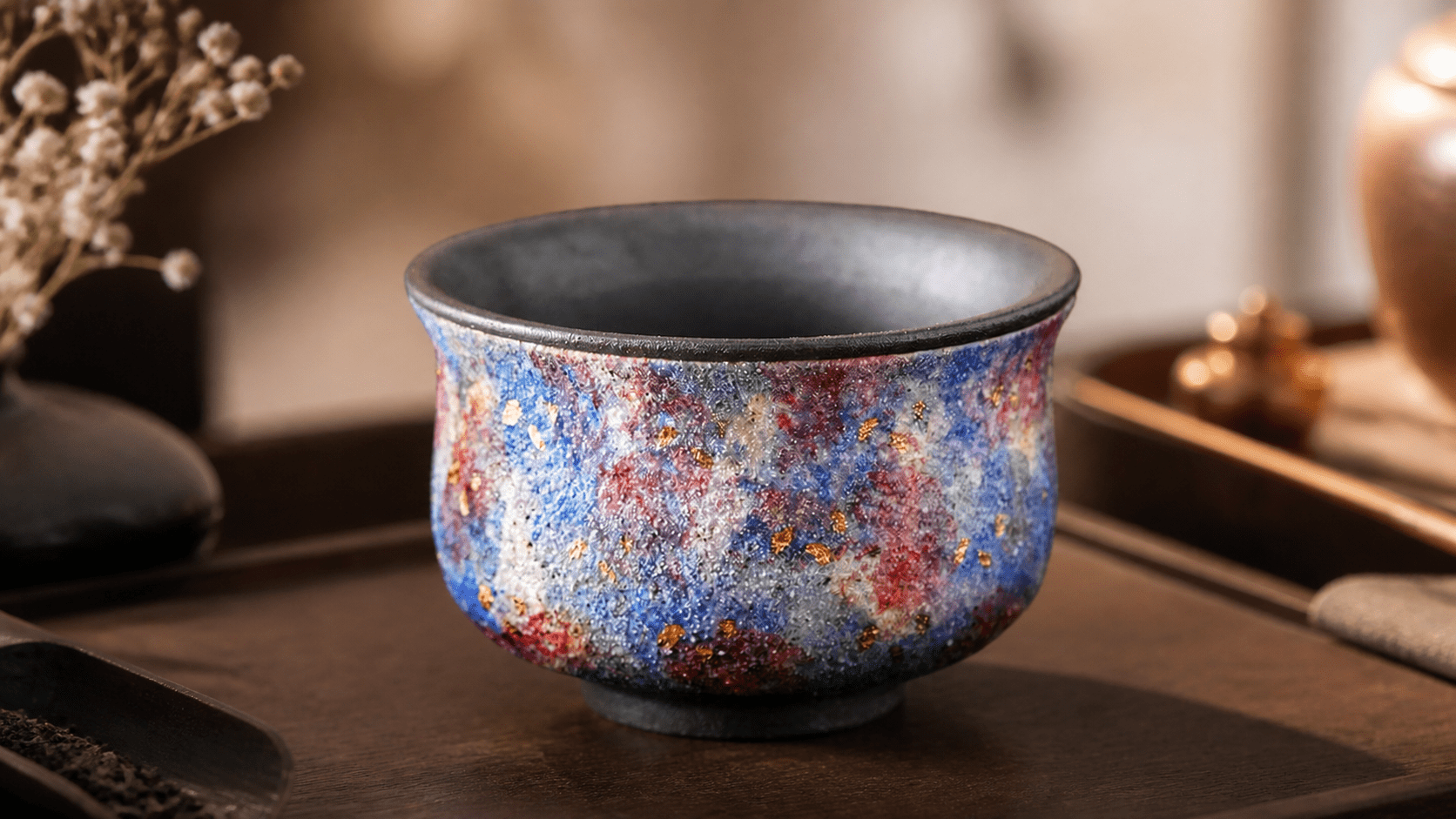
| Masterpiece / limited edition | $500–$2,500+ | Brilliant yohen pattern with multiple colors (blue, gold, silver) reflecting rainbow kiln change. Flawless shape, meticulous spot placement. Extremely rare. | High-end collection, ceremonial use, heirloom item. |
When I think about the best value jian zhan, that sweet spot usually lives in the $120–$300 range. At this level, you’re getting a bowl with the authentic clay, a genuine kiln change effect that will mesmerize you, and the craftsmanship of someone who has studied for at least a decade—without the exponential price jump that comes from an artist who has won national awards. If you’re looking for a handmade tenmoku tea cup that will age gracefully with your tea journey, Explore our handmade Jianzhan tea cups to see pieces I curate personally in that exact bracket.
Is a Tenmoku Tea Bowl Worth the Luxury Price? A US-tinged Analogy
In American culture, we’re comfortable spending on experiences: a round of golf at Pebble Beach, a bottle of Napa cabernet, a pair of hand-welted boots that will outlast us. A tenmoku tea bowl belongs to the same family of considered luxury.
Imagine you’re pouring a rare single-origin oolong in a gongfu tea ceremony. The darkness of the bowl lets you study the exact color of the tea soup with a scientist’s eye. The thick walls hold heat long enough to enjoy the full arc of the flavor. And as you lift the bowl, the oil spots glint under your lamp, never the same on any rotation. That daily 15-minute ritual elevates to a space of calm that no machine-made cup can deliver. Japanese tea masters understood this deeply—centuries ago, they were already paying for the finest tenmoku tea bowls with sums that could purchase entire estates. The price, then, is not for the clay alone; it’s for the daily aesthetic and sensory upgrade it provides.
Plus, a well-maintained jian zhan actually improves with use. Tea oils slowly fill the micro-pores, darkening the surface and bringing out a warm luster in a process known as “nourishing the cup.” It’s akin to seasoning a cast-iron skillet—your investment gets better the more you use it.
How to Find the Best Value Jianzhan Tea Cup (Without Getting Burned)
With demand rising, the market is flooded with lookalikes. Here’s how to spot a genuine piece that justifies its jian zhan cost:
- Insist on Jianyang origin. Reputable sellers name the exact kiln town or artist. If it just says “made in China,” move on.
- Look at the foot ring. A real handmade jian zhan will show a naked, iron-rich clay base (often reddish brown or dark gray) with a rough, natural texture, not a smooth, painted look.
- Observe the oil spots under natural light. Authentic kiln change spots have a subtle metallic shimmer and slight irregularity. Perfectly uniform dots usually mean chemical transfer prints.
- Consider the tea-enhancement claim. While any ceramic can hold tea, true jian zhan measurably softens water because of its iron content and porosity. If a seller can’t speak to the clay source, the bowl likely won’t do wonders for your oolong.
- Buy from a curator you trust. It’s possible to sort through platforms and find a treasure, but I’ve spent years building relationships with Jianyang potters to take the guesswork out for you. To see bowls I’ve hand-selected for their dramatic oil spots, Discover our collection of oil spot tenmoku cups.
Who Should Buy a Handmade Tenmoku Tea Bowl?
If any of these resonate, a tenmoku tea bowl is likely calling your name:
- The gongfu tea beginner: You want one perfect cup that forces you to slow down and appreciate each infusion. Avoid a cheap starter that teaches you nothing.
- The gift seeker for tea lovers: A best jian zhan tea cup in a wooden box outshines any generic tea set. It’s memorable, culturally rich, and usable daily.
- The mindful collector: You appreciate the thrill of kiln change and the link to Song Dynasty aesthetics. Collecting jian zhan can become a lifetime pursuit with infinite variation.
- The daily ritualist: You already have a meditation or coffee ritual. A tenmoku tea bowl brings the same intentional focus to tea, especially for a solo gongfu session after a long day.
FAQ: Tenmoku Tea Bowl Price and Value
Why are tenmoku tea bowls so expensive?
The price covers an exceptionally high failure rate. Each bowl is handmade from rare Jianyang clay, coated in a difficult-to-control iron glaze, and fired for over 20 hours at 1300°C. Only a small fraction survive with bright oil spots, making every perfect bowl a statistical survivor.
What is a kiln change?
Kiln change, or yohen, is the natural crystallization of iron in the glaze during cooling. It creates the oil spot, hare’s fur, or rainbow patterns. No two are alike, and the conditions are so precise that the artist cannot fully control the outcome.
How much does a genuine jian zhan cost?
An authentic handmade jian zhan starts around $50–$150 for basic oil spots and can rise to $500+ for museum-grade patterns. The price reflects clay origin, artist skill, and quality of the kiln change.
Are all tenmoku tea bowls food safe?
Authentic iron glaze jian zhan are completely food safe and have been used for centuries. They contain no lead or cadmium. Avoid ultra-cheap imitations that may use industrial pigments.
Can I use a tenmoku tea bowl every day?
Absolutely. In fact, daily use helps develop the cup’s patina. The thick walls are highly durable, though you should avoid thermal shock (don’t pour boiling water into a freezing cold bowl) and abrasive scrubbing.
What is the best value jian zhan tea cup for a beginner?
Look for a handmade tenmoku tea cup with visible oil spots, a signed base from a Jianyang potter, and a price around $120–$250. This gets you the true experience without the collector’s premium. I’ve curated a selection exactly for this—Explore our handmade Jianzhan tea cups to see what I mean.
Final Thoughts
A tenmoku tea bowl is not a purchase; it’s an entry point. Into the world of Song Dynasty glaze, into the tea ceremony’s quiet mindfulness, and into a global tradition that connects you to both ancient China and the Japanese tea rooms that elevated it to high art. Yes, the tenmoku tea bowl price reflects its rarity, the gamble of the kiln, and the hands that shaped it. But once you hold a true oil spot cup, feel the texture, and sip tea that seems sweeter than before, the cost transforms into a private pleasure that renews itself with every steeping. If you’re ready to find your own jian zhan, I invite you to browse the pieces I’ve traveled to source, and discover why this little black cup has captivated connoisseurs for a thousand years.
Explore Our Collection
Ready to experience the world of tenmoku tea bowl? Browse our curated collection:
Disclaimer: This article is for informational purposes. Products and pricing subject to change.
Compartir:
Why a Tenmoku Tea Bowl Is the Ultimate Luxury Ritual for Daily Wellness
Tenmoku Tea Bowl Price Guide: Why It Costs More and How to Choose Better Value