

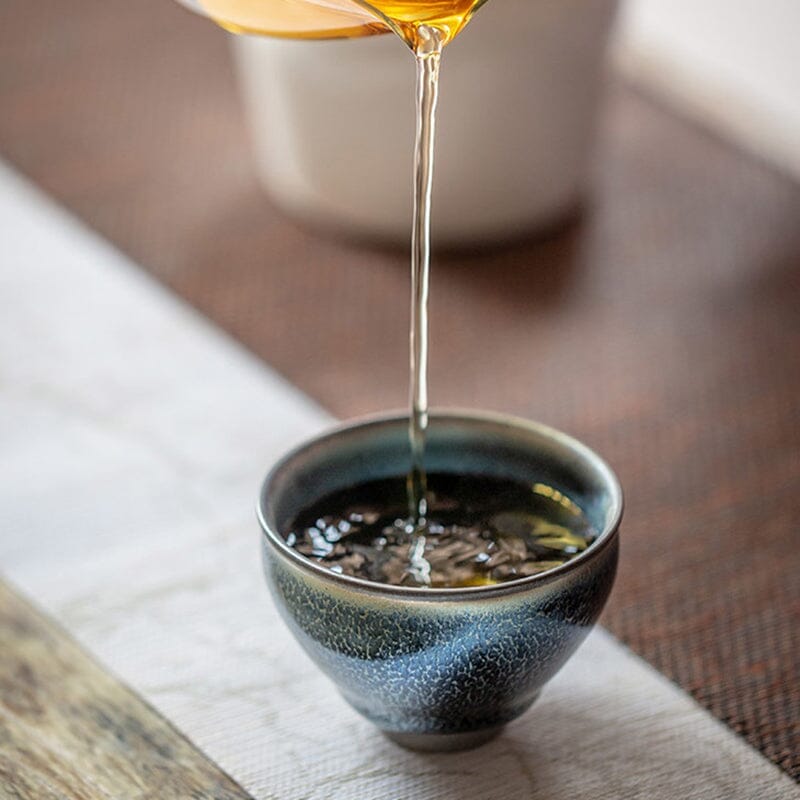
Brewing Dongding Oolong not only requires precise techniques but also relies on reasonable selection of utensils and accurate judgment of tea quality. From the concentration-balancing role of the fairness cup, to the safe practice of simplified tasting procedures, and to the identification of tea tenderness through dry tea and brewed leaves, every detail affects the final tasting experience. This article will delve into Dongding Oolong's utensil adaptation, tasting skills, brewed leaves observation, and dry tea identification methods, helping you advance from "able to brew" to "understanding tea properties" and fully master the quality appreciation logic of Taiwanese oolong.
1. Utensil Selection: Core Role of Fairness Cup and Capacity Adaptation
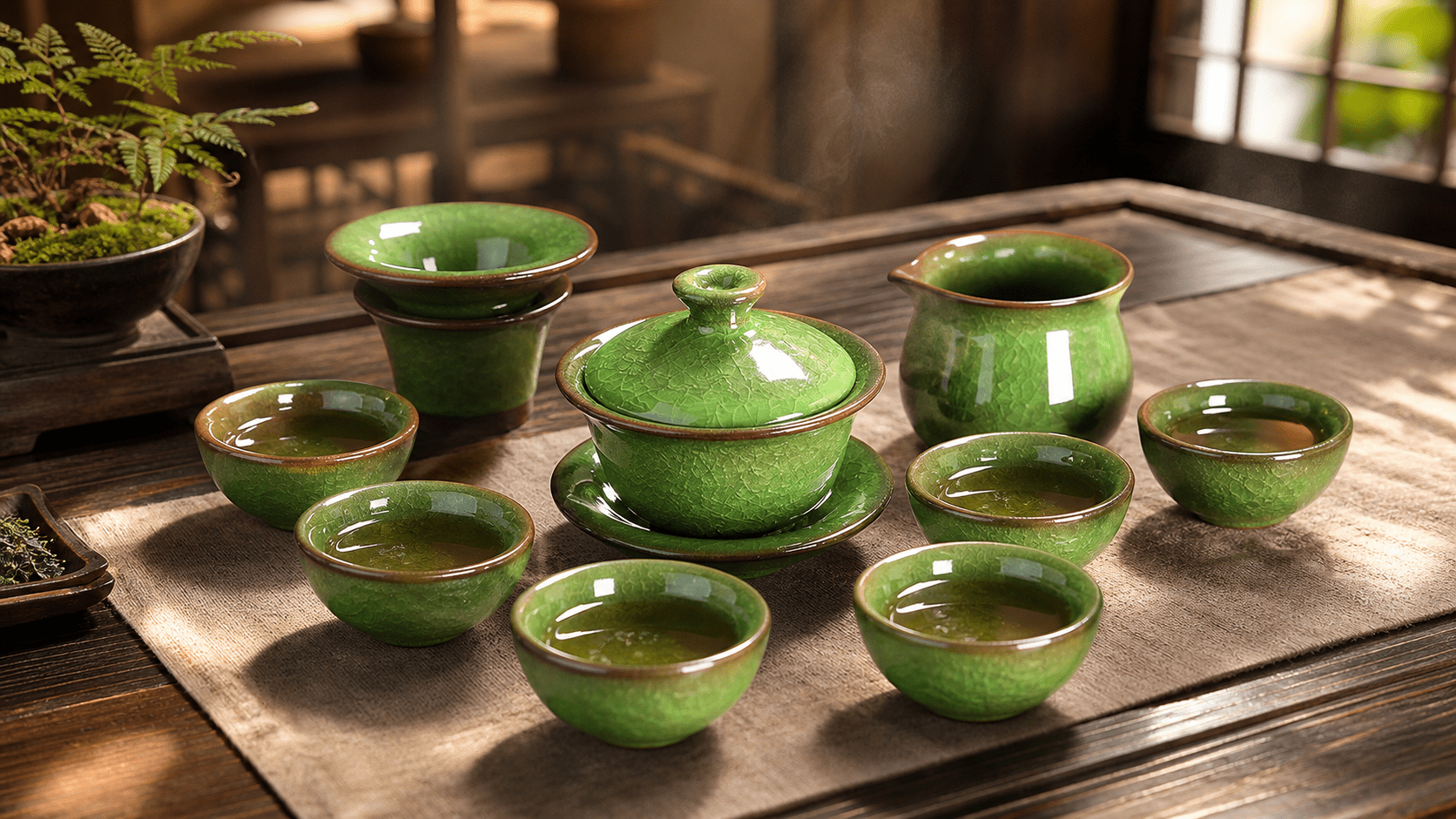
Core role: When brewing Dongding Oolong, the tea soup poured out from the pot first is lighter in concentration, while the later poured one is stronger (due to uneven distribution of tea leaves in the pot and different extraction degrees). After mixing in the fairness cup, the concentration of the tea soup can be balanced, avoiding the "light first then strong" gap during tasting;
Operation points: When serving soup, pour the tea soup from the pot completely into the fairness cup at one time. Wait for the tea soup to mix evenly before distributing it to the tasting cups. Do not pause or pour in batches;
Adaptation principle: The capacity of the fairness cup should be slightly larger than that of the teapot (e.g., a 120ml teapot with a 150ml fairness cup) to ensure that the tea soup can be fully contained without overflow.
Ideal state: The capacity of the purple clay pot should be accurately matched with the fairness cup. One pot of tea can just fill one fairness cup (no residue, no overflow). This can avoid the tea soup remaining in the pot and continuing to soak, which causes bitterness, and ensure uniformity during tea distribution;
Common misunderstanding: If the teapot capacity is larger than the fairness cup, it is necessary to pour soup twice, which easily leads to concentration differences between the front and back tea soup; if the capacity is too small, frequent brewing is required, disrupting the tasting rhythm;
Selection suggestion: Beginners can prefer small and medium-sized purple clay pots of 100-120ml, paired with fairness cups of the same specification, suitable for 5-6 people to taste, making operation easier to control.

2. Tasting Methods: Simplified Procedures and Safety Practices
Omit flipping step: When distributing tea, directly pour the tea soup from the incense cup (aroma-smelling cup) into the tasting cup without inverting and flipping, reducing operation difficulty;
Aroma adjustment: After gently rubbing the incense cup, directly approach the cup mouth to smell the aroma (without flipping and closing), and feel the fresh aroma layers of Dongding Oolong (mainly orchid and honey fragrance);
Tradition retention: Maintain the tradition of "three sips tasting" — the first sip to taste freshness, the second to savor the taste, and the third to swallow slowly and aftertaste, completely experiencing the flavor changes of the tea soup.
Anti-scald key: Omitting the flipping action can avoid the risk of scalding caused by overflowing tea soup, especially suitable for the elderly or children with weak hand strength;
Utensil placement: In the simplified procedure, the incense cup is still placed on the right, and the tasting cup is on the left. When distributing tea, pour slowly along the cup wall to avoid splashing;
Cleaning convenience: After reducing the flipping link, cleaning the utensils is simpler, just rinse the residual tea soup, reducing the operation burden.
3. Brewed Leaves Observation: Intuitive Basis for Judging Tea Quality
Appearance inspection: Observe the shape, size and uniformity of the leaves. High-quality Dongding Oolong's brewed leaves should basically maintain consistent appearance characteristics (mostly oval or slightly elongated), with only size differences and no obvious abnormal-shaped leaves;
Color judgment: The color of brewed leaves should be uniform yellow-green or dark green, without scorch marks, browning or blackening. If the color is mottled, there may be raw material mixing or process defects.
Tree species purity: If the brewed leaves have highly consistent shapes (such as oval with uniform leaf edge serrations), it indicates that they are made from the same tree species with high purity; if there are multiple leaf shapes such as round and lanceolate, it may be a mixture of different tea varieties;
Freshness degree: Tender brewed leaves are soft and tough to the touch, not easy to tear, with clear veins; old brewed leaves are dry and rough, easy to break, with hard veins;
Process judgment: Complete brewed leaves without crumbs indicate moderate rolling and roasting processes; if there are many broken leaves and blackened brewed leaves, it may be due to excessive rolling or high roasting temperature.

4. Dry Tea Identification: Experiments and Skills for Judging Tenderness
Sample selection: Select two typical samples from dry tea — one with darker color (near black or dark brown-green), and one with lighter color (green or yellow-green);
Brewing comparison: Brew the two tea leaves with the same water temperature (95℃) and the same time (15 seconds), and observe the phenomenon:
Dark-colored tea: Due to tight rolling, it will sink to the bottom quickly, unfold slowly, and the tea soup color is darker (golden amber);
Light-colored tea: Due to loose structure, it will float on the water surface, unfold quickly, and the tea soup color is lighter (yellowish green);
Principle analysis: Tender leaves have good fiber toughness and can withstand tighter rolling (hence dark color and tight structure); old leaves have fragile fibers and are easy to loosen during rolling (hence light color and loose structure).
Color law:
High-tenderness Dongding Oolong dry tea has darker colors (dark brown-green, dark green), and the higher the proportion, the better the tea quality;
Old leaf dry tea has lighter colors (yellow-green, light green). If the proportion is too high, the taste is easy to be plain and the durability is low;
Touch difference:
Tender dry tea: Smooth and tough when rubbed with fingertips, not easy to break, with a "fleshy" touch;
Old dry tea: Dry and rough when rubbed, easy to break, with a stiff touch;
Durability verification: Tender leaves can be brewed 7-10 times with remaining fragrance, while old leaves will have significantly lighter taste after 3-5 infusions, with plain tea soup.
5. Post-Brewing Verification: Brewed Leaves Touch and Practical Suggestions
(1) Comparison of Brewed Leaves Touch
Tender brewed leaves: After fully unfolding, they are soft in texture, elastic when gently pinched with fingers, not easy to tear, with thin veins;
Old brewed leaves: Coarse and hard in texture, easy to break when held, with thick and obvious veins, and may have withered edges.
(2) Practical Suggestions
Comparative experiment: Purchase different grades of Dongding Oolong, compare dry tea color, brewed leaves shape and touch after brewing, and establish intuitive cognition;
Record summary: After each brewing, record the number of durable infusions, changes in tea soup color and brewed leaves state, and gradually accumulate identification experience;
Combining origin: Tea from Dongding Oolong's core producing area (Dongding Mountain) has a higher proportion of tender leaves and softer brewed leaves due to high altitude (above 1200 meters) and foggy environment, which can be used as a quality reference benchmark.

6. Knowledge Summary: Key Points of Dongding Oolong Brewing and Identification
The advanced way of Dongding Oolong combines "utensil adaptation" and "quality identification". From the concentration balance of the fairness cup, to the safe practice of simplified tasting; from judging tree species purity through brewed leaves shape, to revealing tenderness rules through dry tea color — each link teaches us to "read the language of tea". When you can predict durability through dry tea color and verify quality through brewed leaves touch, you have transcended simple brewing techniques and entered the advanced realm of "understanding tea properties and flavors". This attention to details not only allows you to brew the best flavor of Dongding Oolong but also lets you feel the unique charm of Taiwanese alpine oolong and natural gifts during tasting.
Compartir:
Brewing Oolong Tea - Dongding Oolong (Part I): Classic Oolong Brewing and Flavor Exploration
Brewing White Tea – Silver Needle (Part I): From Variety Cognition to Basic Brewing Guide