

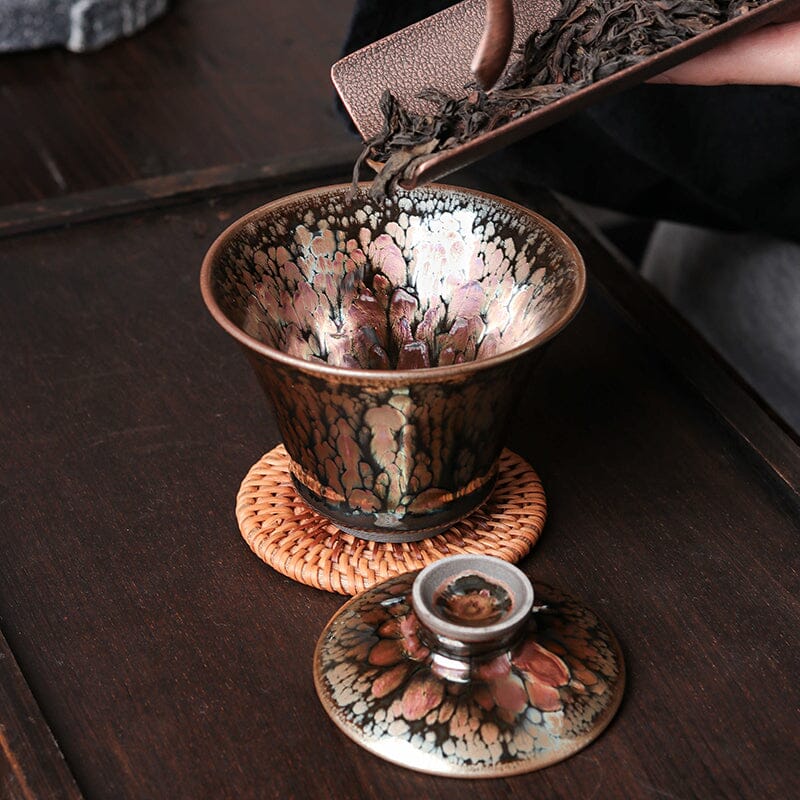
Jinjunmei, a treasure among Chinese black teas, is beloved by tea enthusiasts for its rich floral and fruity aroma, sweet and mellow taste, and bright golden soup color. To fully showcase Jinjunmei's unique charm, mastering standardized brewing procedures and detailed control is crucial. This article will systematically explain the basic brewing methods of Jinjunmei from tea table setup, utensil preparation to specific brewing steps and tasting etiquette, helping you get started with the essence of black tea brewing.
1. Tea Table Setup: Creating an Elegant Brewing Space
(1) Number of People and Utensil Configuration
Main brewer: A purple clay teapot (preferably 100-120ml, conducive to aroma retention and moisture preservation);
Auxiliary utensils: A fairness cup (to balance tea concentration), a tea strainer (to filter tea residues);
Other tools: Tea caddy (for storing tea), tea spoon (for taking tea), tea lotus (for appreciating tea), tasting cups (3, corresponding to the number of people), kettle (for boiling water), etc., collectively called "six-way utensils".
(2) Utensil Placement Principles
Core Positioning: With the brewer as the center, all utensils are arranged radially around the brewer, ensuring easy reach and reducing unnecessary movements.
Hierarchical Layout: Arrange from "low to high" – place short utensils such as tasting cups and tea lotus at low positions, and kettles, tea caddies at high positions. This conforms to visual aesthetics and avoids blocking the view during operation.
Movement Planning: Place commonly used utensils (such as purple clay teapots and fairness cups) in the core area in front, and spare utensils (such as tea needles and tea towels) on the side to ensure a smooth brewing process without cross-interference.

2. Warming and Cleaning Utensils: Activating Utensils, Laying the Foundation
(1) Core Purposes
Increasing Utensil Temperature: Preheat purple clay teapots, fairness cups, etc., with boiling water to prevent the subsequent hot water from cooling due to heat absorption by utensils, ensuring uniform heating of tea leaves;
Cleaning and Sterilizing: Remove dust and odors from the surface of utensils through high-temperature rinsing, ensuring the tea soup is pure and free of foreign flavors;
Awakening Utensil Activity: Especially for purple clay teapots, the warming process can open the pores of the pot body, preparing for subsequent "pot cultivation" and aroma absorption.
(2) Operation Points
Water Temperature and Flow: Use just-boiled water (100℃), with a slow and uniform water flow, poured along the inner wall of utensils. Avoid direct impact on the bottom of pots or cups to prevent utensils from cracking due to sudden temperature changes;
Comprehensive Infiltration: Purple clay teapots need to be rinsed inside and out, ensuring the lid, spout, and body are all soaked in hot water; fill fairness cups and tasting cups with hot water and let stand for 10-15 seconds for full preheating;
Draining Water: After warming, completely pour out water from utensils to avoid residual water diluting the tea concentration and affecting the flavor.
3. Tea Awakening Skills: Awakening Tea Properties, Activating Flavor
(1) Tea Quantity Control
Key principle: Too much tea easily makes the soup strong and astringent, while too little makes the flavor weak;
Easily confused point: Compressed black tea (such as some processed broken black tea) can have a slightly reduced amount (about 1/4) because the volume of compressed tea will expand after unfolding. However, Jinjunmei is whole-bud loose tea, so the amount can follow the standard 1/3.
(2) Tea Awakening Steps
Putting Tea into the Pot: Use a tea spoon to take Jinjunmei from the tea caddy and gently put it into the purple clay teapot to avoid tea scattering;
Water Infiltration: Pour a small amount of hot water (just enough to submerge the tea leaves), with the water volume standard being "just covering the tea buds", not too much;
Quick Draining: Gently rotate the purple clay teapot to let the tea leaves absorb water evenly, then immediately pour out the awakening water (this water is not for drinking), aiming to awaken tea properties rather than extract flavor;
Pot Cultivation Details: After awakening, gently wipe the tea stains on the surface of the purple clay teapot with a tea towel or maintenance brush, which can clean the pot body and accumulate patina for long-term pot cultivation.

4. Formal Brewing: Precise Control, Releasing Charm
(1) First Infusion: Warming the Pot, Water Injection and Soup Serving
Temperature Control: Jinjunmei is a fully fermented black tea with delicate buds, so the water temperature is preferably around 80℃ (let boiling water cool for 30 seconds). Too high temperature easily destroys the aroma and produces a cooked taste, while too low temperature makes it difficult to release the flavor;
Water Injection Skill: Adopt the "wall-circling injection" method, with water flowing slowly into the purple clay teapot along the inner wall, keeping the water flow gentle and stable. Avoid directly flushing the tea leaves to prevent crumbs from rising and making the soup turbid;
Soup Serving Speed: After sufficient awakening, the first infusion should be served slowly and steadily – tilt the teapot body at a constant speed to let the tea soup slowly flow into the fairness cup. Avoid shaking the teapot body during the whole process to ensure the soup is clear.
(2) Tea Serving Etiquette: Standard Operation, Conveying Respect
Capacity Control: When serving tea into tasting cups, fill them to 80% full – this is convenient for holding and tasting, and leaves space to gather aroma, avoiding overflow and scalding;
Direction and Angle: When serving tea, the spout of the purple clay teapot (or fairness cup) should be parallel to the tasting cup, with consistent direction and gentle and coherent movements, reflecting "focus and respect";
Avoid Spilling: Adopt the "inner protection" method for serving tea, i.e., keep the spout close to the cup mouth and pour slowly along the cup wall, avoiding splashing or leakage to keep the tea table clean.
(3) Tasting Points: Mobilizing Senses, Experiencing Layers
Tasting Posture:
Men: Adopt the "fist-holding style" – gently hold the cup body with the palm, and lightly press the cup edge with the thumb, steady and powerful;
Women: Adopt the "flower-holding style" (orchid fingers) – gently hold the cup bottom with the index and middle fingers, and lightly support the cup edge with the thumb, elegant and natural.
The cup mouth should be Directly facing the lips to avoid spilling.
Tasting Steps:
Observe soup color: Jinjunmei's soup is golden or orange-yellow, clear and bright. First appreciate the luster and transparency of the soup;
Smell aroma: Gently shake the cup and inhale deeply to feel the floral and fruity aroma (such as honey fragrance, orchid fragrance) on the cup lid or mouth;
Taste flavor: Taste in three sips – the first sip is a light sip to feel the Entrance sweetness; the second sip is held in the mouth, with the tongue gently flipping to let the soup contact all parts of the mouth (sweetness at the tip, moisture on the surface, aftertaste at the bottom); the third sip is swallowed slowly to experience the lingering rhyme in the throat.
Core Elements: Tasting should focus on the five key points of "compassion, observing soup color, smelling tea aroma, tasting flavor, and feeling tea juice by tongue flipping", experiencing the hierarchical changes of the soup with a focused heart.

5. Second Infusion Brewing and Tasting: Showing the Essence of Tea
(1) Brewing Skills
Water Injection and Soup Serving: Continue the principle of "gentle pouring and slow brewing" – slow down the water injection speed to let hot water fully contact the tea leaves; serve the soup slowly and evenly to avoid uneven extraction due to too fast speed;
Temperature and Time: Maintain the water temperature at 80℃, and extend the brewing time by 5-10 seconds compared to the first infusion (about 15-20 seconds), which can be adjusted according to the soup concentration;
Utensil Cooperation: When serving soup with a purple clay teapot, be careful not to block the air hole on the lid, otherwise, the water flow will be interrupted due to pressure imbalance, affecting the smoothness of soup serving.
(2) Flavor Characteristics and Misunderstanding Correction
Flavor Performance: The second infusion of Jinjunmei has a more intense aroma and fuller taste, with a balance of sweetness and floral-fruity aroma, clearly showing the core quality of the tea;
Misunderstanding Correction: The traditional saying "first infusion is water, second infusion is soup" does not apply to Jinjunmei – as long as the tea is fully awakened and the leaves are fully unfolded, the second infusion is the beginning of the best flavor, not "watery" or "light";
Key Logic: Jinjunmei is made of whole buds with rich internal substances. After adequate awakening, the second to fourth infusions are the essence of the flavor. Stable temperature and time control are needed to fully release its quality.
6. Utensil Use and Division of Labor: Standard Operation, Improving Efficiency
(1) Left-Right Hand Division Principle
Right hand: Operates right-side utensils (such as main operations of purple clay teapots and fairness cups), responsible for core actions such as water injection, soup serving, and tea serving;
Left hand: Operates left-side utensils (such as taking tea, handing cups, cleaning the tea table), assisting in completing non-core steps;
Core requirement: Avoid cross-operation (such as the right hand reaching across the left side of the body to take things) to reduce redundant actions and ensure a coherent process.
(2) Key Utensil Operation Details
Purple Clay Teapot Air Hole: When serving soup, gently hold the lid with fingers, avoiding pressing the air hole, otherwise, the water flow will be blocked; if you need to control the soup serving speed, you can gently lift the edge of the lid instead of blocking the air hole;
Function of Fairness Cup: Balances the concentration difference between infusions – the previous infusion is lighter, and the later is stronger. After mixing in the fairness cup, the tea soup for each taster has a consistent concentration, reflecting the meaning of "fairness";
Tea Strainer Use: Place it at the mouth of the fairness cup, pour slowly when serving soup to filter residues, but pay attention to timely cleaning of residual residues on the strainer to avoid blocking and affecting the flow rate.
(3) Action Standards
Handle gently: All utensils should avoid collision, with no noise during operation, reflecting the "quiet" tea etiquette;
Stable water flow: Whether it is water injection, soup serving or tea serving, the water flow speed should be uniform to avoid turbidity or uneven concentration caused by sudden speed changes;
Focus and calmness: The brewer should maintain a calm mood and steady movements to avoid operational errors due to impatience, because "the brewer's state directly affects the tea soup quality".

Brewing Jinjunmei is both a technique and an art – precise tea quantity, appropriate water temperature, and smooth movements are the foundation, while a focused mood and reverence for tea are the keys to enhancing flavor. From the elegance of tea table setup to the calmness during tea serving, from the awakening of the first infusion to the blooming of the second, every link needs to be experienced with care. Through repeated practice, mastering the essence of "gentle pouring, slow brewing, focus and calmness", you will be able to fully release Jinjunmei's floral-fruity sweet aroma and Warm soup, and feel the unique charm of black tea.

Compartir:
The Meaning of Chan Tea: Pu'er (Part II) – A Guide to Deep Integration of Mindset and Technique
Jin Jun Mei Brewing Advanced (Part II): From Technique to Tea Ceremony