

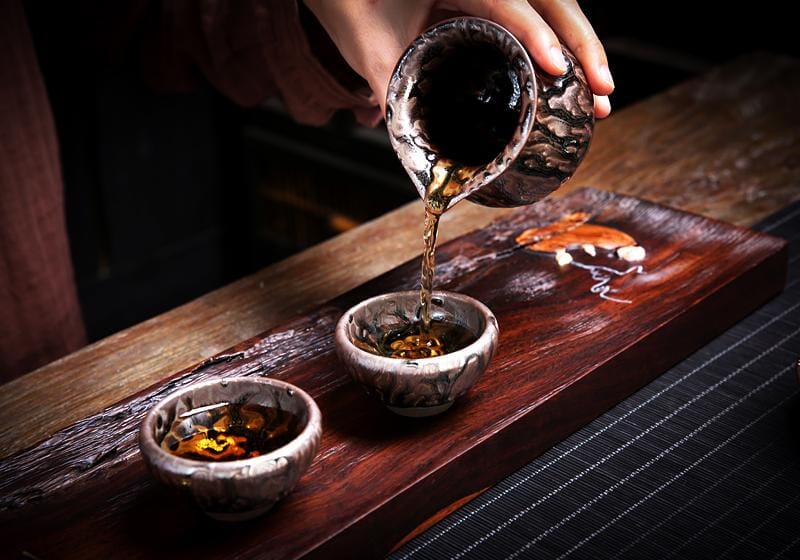
To work out how many tea cups one gaiwan pour will fill, divide the amount of tea you actually decant by the portion you want in each cup. Count complete portions by rounding down. For example, 120 ml of finished tea makes four 30 ml portions or three 40 ml portions. These are planning examples, not measurements of the pictured tea set.
Start with the pour, rather than the number of cups in a boxed set. A cup can hold more than you intend to serve, and a gaiwan's listed capacity does not tell you exactly how much tea will reach the cups during your session.
Keep three different volumes separate
Use milliliters throughout your plan so you are comparing the same unit:
- Listed capacity: the volume stated by the seller. Check how it was measured.
- Decanted yield: the tea that reaches your serving pitcher after an infusion.
- Cup portion: the amount you choose to serve each person in that round, below the cup's rim.
For an example of why the distinction matters, Red Blossom's Summer Gaiwan listing explicitly identifies its volumes as brim measurements and notes that functional volume can differ. That is a disclosure about its own product, not a measurement rule we can assume for every seller or for Tenmokus.
Do not apply a fixed percentage to all gaiwans. Record your own decanted yield with your usual tea and fill level. A water-only check can help you rehearse the transfer, but it does not establish the yield of a session with leaves inside.
Make a Yield / Portion / People note
Use this three-part worksheet from Tenmokus Editorial Team to separate the serving decision from the appearance of a set. It is an editorial method, not a product test.
- Yield: collect a normal infusion in your serving pitcher. Let the tea cool before transferring it into a rinsed graduated measuring jug. Record the amount in milliliters. If you want to compare several rounds, measure them separately.
- Portion: with a cool, empty cup and room-temperature water, choose a comfortable serving level below the rim. Transfer that water into the measuring jug and record the amount. Repeat for each different cup shape you plan to use.
- People: count everyone drinking, including yourself. Multiply that number by your chosen portion. Compare the result with the yield you recorded.
Use a jug with graduations fine enough for these small amounts. Treat a coarse kitchen measure as an estimate; do not turn an approximate reading into an exact product specification. Do not fill a cup to the brim just to make the arithmetic work.
Tea needed for one round = people × portion per person. If the result exceeds the measured yield, choose smaller portions that everyone is happy with, or plan another infusion.
Work through the cup count
The numbers below are illustrative. They are neither recommended universal serving sizes nor the capacities of the Oni pieces shown here.
| Yield | Per cup | Full portions | Left over |
|---|---|---|---|
| 120 ml | 30 ml | 4 | 0 ml |
| 120 ml | 40 ml | 3 | 0 ml |
| 120 ml | 50 ml | 2 | 20 ml |
| 150 ml | 40 ml | 3 | 30 ml |
In the last example, dividing 150 by 40 gives 3.75. That means three complete 40 ml portions, not four. To serve four people equally from that same 150 ml, each would receive 37.5 ml. In practice, select an easy-to-measure smaller portion and allow for any liquid left behind during serving.
If your cups differ in size, decide whether you want equal portions or different amounts. For equal portions, choose an amount that fits comfortably in the smallest cup. For different amounts, add them: 30 ml + 40 ml + 50 ml needs 120 ml. Matching the visible fill height across unlike cup shapes is not a volume measurement.
Check the pitcher between the gaiwan and cups

The Oni catalog scene shows the first transfer: gaiwan to serving pitcher. The photograph documents the arrangement, not a measured yield or a pouring test.
The current Oni Tea Set photographs show this transfer and the next step, pouring from the pitcher into individual cups. Treat them as two separate capacity checks: the pitcher needs usable space for the whole decant, and the cups need space for the portions you choose.
Before a session, rehearse the planned volume with room-temperature water and leave room below the pitcher's rim. If your pitcher cannot accommodate the planned decant comfortably, choose a larger serving vessel. A row of matching cups does not, by itself, demonstrate how many full portions the gaiwan supplies.
Use the result before buying more cups
Red Blossom's guide to brewing for a group describes its own approximately 150 ml gaiwan serving four to six matching tasting cups. That is a useful example of a small-portion session, not a promise that every 150 ml gaiwan fills six cups of any size.
Keep a short note: my usual yield; my preferred portion; people per round; pitcher checked. If you already like your cups, start by adjusting the serving plan. If you are choosing a set, ask how the stated capacities were measured and compare them with the portions you actually want.
For the broader equipment layout, use our beginner gongfu tea setup guide. Then compare current Tenmokus tea sets, checking the individual product details before choosing. Choose for the number of comfortable portions you want in one round, not simply the number of cups in the photograph.


Share:
Choosing a Saucer for a Tenmoku Tea Cup