We use UPS & Fedex for fast and reliable shipping.

Choose a saucer for a Tenmoku tea cup by checking three things: where the cup's foot sits, whether the cup's sides clear the saucer, and whether you can lift the cup comfortably. Start with the cup you own. A saucer's outside diameter alone does not tell you whether its center will accommodate the foot.

Our suggested order is Seat → Clear → Lift. Complete those checks before choosing a color or buying several matching saucers. The photographs below are existing Tenmokus product scenes; this guide does not claim a tested cup-and-saucer pairing.

Start with the foot, not the opening

In the current Oni tea cup photographs, the mouth is visibly wider than the foot. The hand-supported side view makes that difference easier to see than an overhead view. This is an observation about the pictured cup, not a measurement or a rule for every Tenmoku cup.
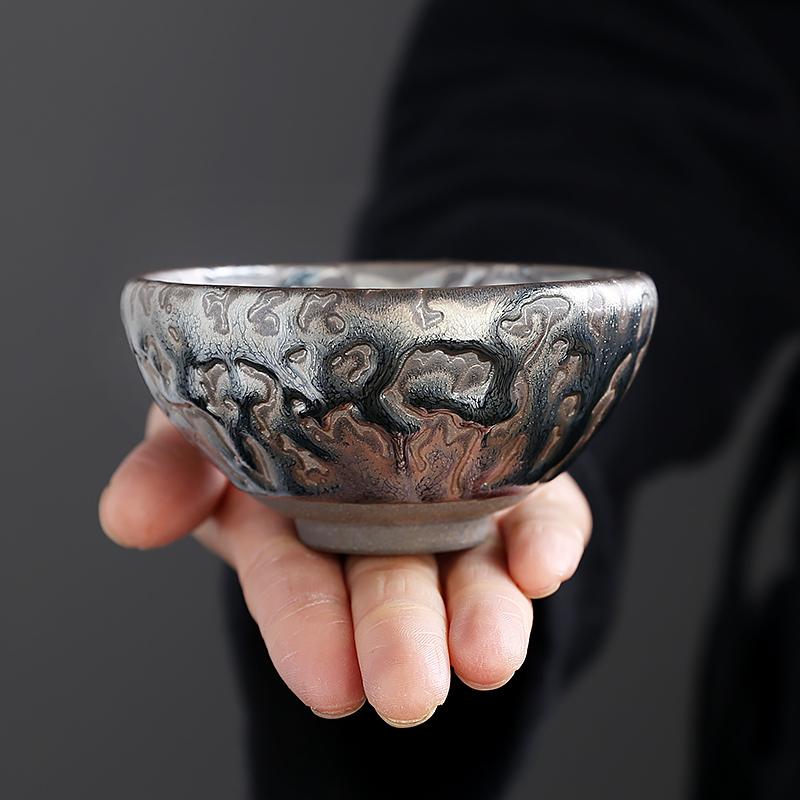
Oni tea cup resting on an open hand, showing a broad rim above its narrower standing foot
The hand-supported view reveals the foot below the curved cup wall. Use your own cup for measurements; a hand in a photograph is not a scale.

With the cup empty and dry, measure the outside width of the foot that rests on the table. Record it in millimeters. If you cannot see or measure the foot confidently, ask the cup seller for that dimension and a side or underside photograph. Do not substitute the rim diameter or estimate the base from the listed capacity.

Read the saucer's center dimensions

Look for two separate measurements: the saucer's overall width and the usable area where the cup sits. A product listing may call the latter a cup well, recess, or center. Also inspect the side profile: a raised edge can sit close to the cup's outward-curving wall.

For a concrete example, Teabloom's glass saucer listing distinguishes a 135 mm overall diameter from a 50 mm cup well on its small size, and 160 mm from 55 mm on its large size. Those are dimensions for those saucers, not a recommendation that either fits Oni. They show why the larger headline measurement is only part of the decision.

Other listings provide different information. Tezumi's Wood Grain Chataku lists an overall width of 11.3 cm and describes a grooved center, while Nalata Nalata's Small Teacup and Saucer explicitly describes a center dip for its paired cup. If the usable center measurement is missing, ask for it rather than assuming that similar-looking pieces fit.

Use the Seat, Clear, Lift check

1. Seat: does the whole foot rest in the intended area?

Compare the actual cup foot with the saucer's usable center. A foot wider than a recess will not sit wholly inside it. If the measurements are equal or very close, request an actual fit check instead of treating nominal numbers as proof. There is no universal clearance allowance established for the combinations in this guide.

When you have both pieces, set the empty cup down gently on the saucer on a stable table. Reject the pairing if the cup rocks, sits tilted, or rests on the sloping edge of the recess. Do not press it into place.

2. Clear: does the saucer leave room below the cup wall?

Look from the side. Confirm that the cup rests on its foot and that the saucer's raised edge does not prop up the cup's body. For a broad, low cup, a photograph from above can hide this relationship. Ask for a side view of the proposed pairing if you are shopping remotely.

3. Lift: can you pick up and replace the cup naturally?

Try the movement with the cup empty. Check that your fingers can approach your usual grip without bumping the saucer edge or nearby teaware. If the arrangement feels cramped, choose a different saucer profile or give the cup more space. Keep this check at the table; it is not a test of whether the saucer can carry a filled cup around the room.

A tray photograph is not a saucer fit check
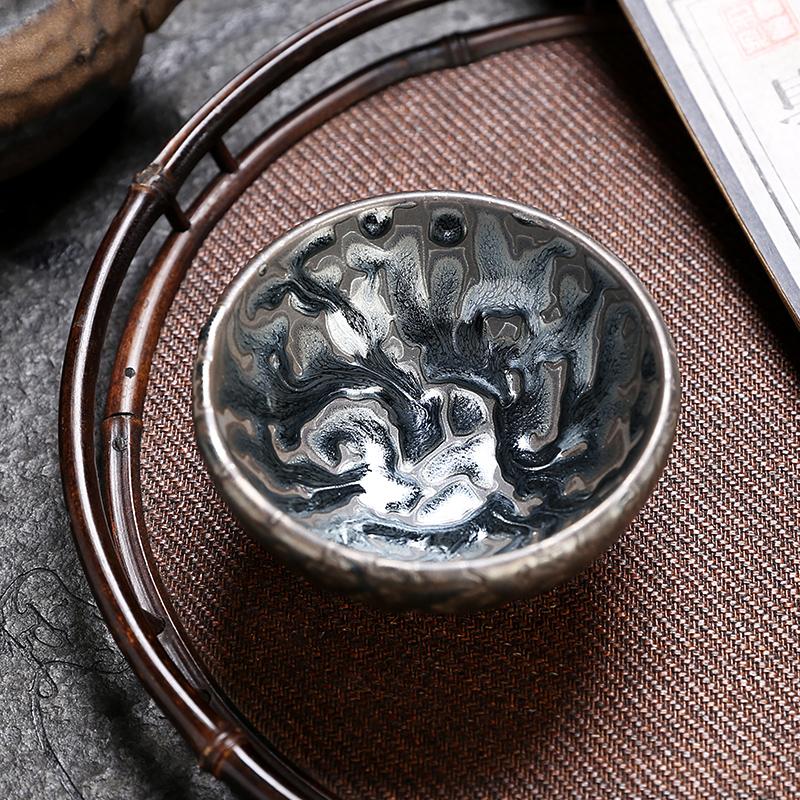
Empty Oni tea cup on a broad woven tray beside a book, with open space around the cup
This Tenmokus scene shows open space around Oni on a tray. It does not show a fitted saucer or establish compatibility with a separate accessory.

Use a scene like this to consider the space around your cup, then assess the actual saucer separately. If your existing setup already gives the cup a suitable place to rest, you may not need another piece. For the wider arrangement, see our small tea-table setup guide.

Ask this before ordering

My cup's foot measures ___ mm across. What is the usable width of this saucer's center? Could you show the side profile and confirm whether the cup rests on its foot without the saucer edge touching its body?

Keep a short record: cup name, foot width, saucer center width, side-clearance result, and empty-cup lift result. Mark anything you have not checked as unknown. A named matching set or a seller's comparison can narrow your choices, but do not transfer that compatibility to a different cup.

Choosing the cup first? Browse the Tenmokus tea cup collection, compare the individual product photographs and specifications, and request missing base measurements before buying a separate saucer. Choose the pairing by fit, then by appearance.
Quick answers for Tenmoku teaware shoppers

Use this guide to connect the article topic with practical buying decisions: what Jianzhan Tenmoku teaware is, who it suits, how to choose a piece, and how to care for it after purchase.

How to use this guide before buying

Read the article first for the main explanation, then compare the product photos, glaze variation, form, seller clarity, return policy, and whether the piece fits daily tea, display, collecting, or gifting.

Common buying mistakes to avoid

Avoid choosing only by dramatic claims, copied photos, unusually low prices, or vague master language. A better decision uses visible product details, clear use case, realistic care needs, and trustworthy shop policies.

Recommended next step

After reading, compare a few real products side by side by size, glaze family, rim shape, capacity, price, and gift suitability instead of relying on one photo or one keyword.

What is Jianzhan Tenmoku teaware?

Jianzhan Tenmoku teaware is ceramic tea ware known for dark mineral-glaze effects and natural kiln variation. Common forms include tea cups, bowls, teapots, tea sets, and matcha bowls.

Who is it best for?

It is best for tea drinkers, ceramic collectors, and gift shoppers who value functional objects with visible handmade character. It is not ideal if you need every piece to look exactly identical.

How do I care for it?

Hand wash with warm water, avoid abrasive cleaners, and dry fully before storage. Gentle daily use helps preserve the surface and keeps the glaze easy to inspect over time.

How do I choose the right Tenmoku piece?

Choose by the main use first: daily tea, matcha, Gongfu brewing, display, or gifting. Then compare capacity, rim shape, glaze family, photos, and whether natural variation is acceptable for your needs.

Is Jianzhan Tenmoku teaware good as a gift?

Yes. It works well for tea lovers, ceramic collectors, birthdays, holidays, and housewarming gifts because it is both usable and visually distinctive. For gifts, choose an easy-to-use form and a glaze style with clear photos.

Related products and categories

Compare the guide above with real Tenmokus categories and representative pieces. Start with the use case, then compare glaze style, form, price, and whether the piece is mainly for daily tea, display, collecting, or gifting.

Handmade Tenmoku tea cups

Best for daily tea drinking, first Jianzhan purchases, ceramic gifts, and comparing glaze patterns across cup shapes.

Tenmoku tea sets

Best when you want a coordinated tea table, a hosting setup, or a complete gift instead of one individual cup.

Real vs fake Tenmoku guide

Use this guide to compare seller claims, glaze appearance, photos, and practical buying signals before choosing a piece.

Vivid Peacock

A representative Tenmoku tea cup to compare by glaze depth, cup shape, price, and gift fit.

Golden Peacock

Compare this piece when you want a clear visual reference for a gold-toned Tenmoku glaze style.

Fairy II

Use this product as another comparison point for handmade form, glaze variation, and gift suitability.

shop handmade Tenmoku tea cups compare Jianzhan teapots browse Tenmoku tea sets choose Tenmoku matcha bowls view Tenmoku tea cups read the real vs fake Tenmoku tea bowl guide browse Jianzhan buying guides learn about Tenmokus

From Tenmoku guide to teaware choice

Tenmokus is focused on handmade Jianzhan Tenmoku teaware for tea rituals, display, and gifting. If you are choosing after reading this guide, start with Tenmoku tea cups for daily tea tasting, Tenmoku teapots for loose leaf brewing, Tenmoku coffee cups for daily coffee, Tenmoku tea sets for coordinated gifts, Tenmoku matcha bowls for matcha preparation, Tenmoku beer cups for home bar drinkware, or Tenmoku sake sets for serving and display.

Related Tenmoku guides

Keep exploring Tenmoku care, gift ideas, teaware selection, and the difference between Tenmoku and Jianzhan.

View all

Choosing a Saucer for a Tenmoku Tea Cup

Choosing a Saucer for a Tenmoku Tea Cup

Choose a saucer for a Tenmoku tea cup by checking three things: where the cup's foot sits, whether the cup's sides clear the saucer, and whether you can lift the cup comfortably. Start with the cup you own. A saucer's...

Read more

How to Pack Tenmoku Tea Cups for Moving

How to Pack Tenmoku Tea Cups for Moving

To pack Tenmoku tea cups for a move, wrap each cup separately, give it a padded compartment that fits its widest point, and keep ceramic surfaces from touching. Check the rim and foot before packing, record which cup goes in...

Read more

Tenmoku Cup Photography: Five-View Record

Tenmoku Cup Photography: Five-View Record

Learn a five-view method for photographing a Tenmoku cup with consistent light, scale, and notes so glaze details remain useful for comparison.

Read more