

A gongfu tea tray fits your tea set only when its usable surface holds the pieces you plan to use and lets you lift, pour, and return them without moving another vessel out of the way. Before buying, mark out the proposed working area on paper, arrange your empty teaware inside it, and rehearse those movements. Count the places needed during brewing, not just the objects in a display photograph.
This is a Tenmokus editorial planning method for checking a tray before purchase. It is not a measured tray test or a universal size recommendation.
Start with the pieces for one session
Choose the number of cups you normally put into use. Set aside spare cups, packaging, and decorative objects for the first layout. Place the brewing vessel, its saucer if used, the serving pitcher, and the strainer with its stand on the table. Add a separate resting place for a lid if your routine involves taking it off.
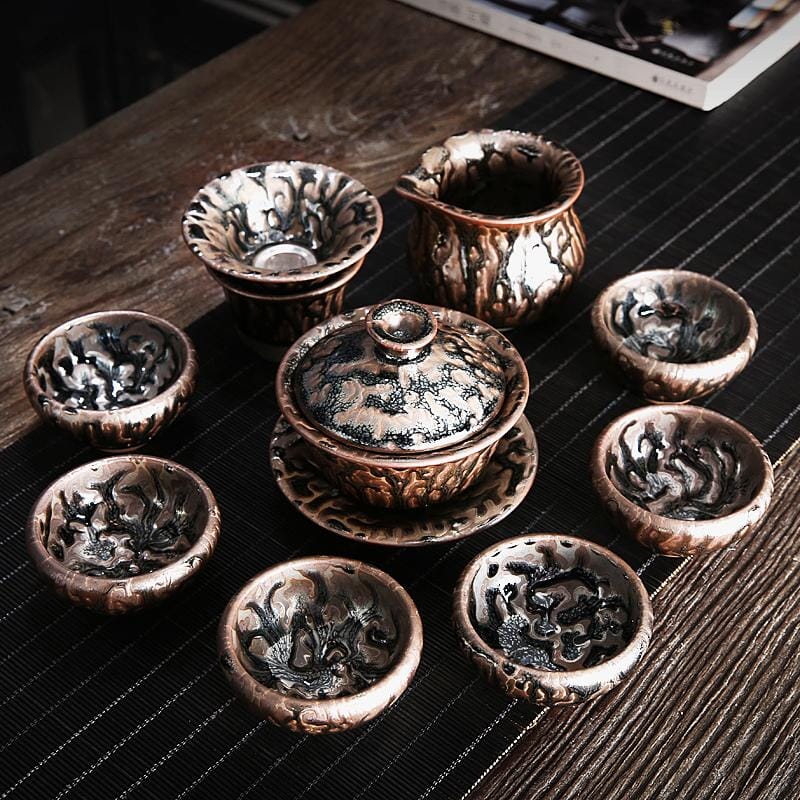
The cover photograph from the Oni Tea Set product gallery shows six cups grouped around a lidded bowl, pitcher, and strainer on a dark mat. It is useful for identifying the objects you might need to place. It does not establish the smallest tray they fit on, or mean that every cup must stay beside the brewer throughout a session. Confirm the current included-pieces list separately from the scene props.
Ask for usable surface dimensions
A listing's overall length and width do not tell you where each vessel can stand. Ask for the dimensions of the flat working surface inside any raised border, and note openings, curved edges, or other areas that will not support a vessel's foot. Check the full width of each piece, including a projecting handle, spout, or saucer, rather than measuring its base alone.
Keep surface fit separate from liquid capacity. For example, Teasenz's ceramic tea boat listing describes a removable perforated lid and a 320 ml liquid capacity. That is a specification for that seller's tray; it does not tell you which arrangement of your teaware will fit on top. Nor does a broad surface alone establish drainage or reservoir capacity.
Make a full-size outline, then lift and return
- Outline the candidate surface. Mark its usable length and width on paper on a stable table. For a round or irregular tray, ask for an overhead drawing or dimensions that let you reproduce the usable shape. Do not substitute a rectangle for a rounded corner you need to use.
- Place empty, room-temperature pieces. Put the brewing vessel, pitcher, and session cups inside the outline. Give the strainer and lid their own landing places when they are off the vessel. Keep the kettle outside this paper exercise.
- Rehearse the sequence without water. Lift the brewer toward the pitcher, return it, lift the pitcher toward the cups, and return it. Check whether fingers, handles, or spouts meet another object. Repeat from your normal seated position.
- Record the obstruction. If something collides, note which movement failed. Try fewer cups in the working zone or a different arrangement before choosing a larger tray. Remove the paper before any brewing; it is only a layout template.
There is no fixed gap in this method. The useful gap is the one that permits your intended movements with your own pieces. A paper outline cannot check a tray's raised rim, surface stability, load limit, or behavior with liquid; those remain separate product checks.

Check the landing places between pours
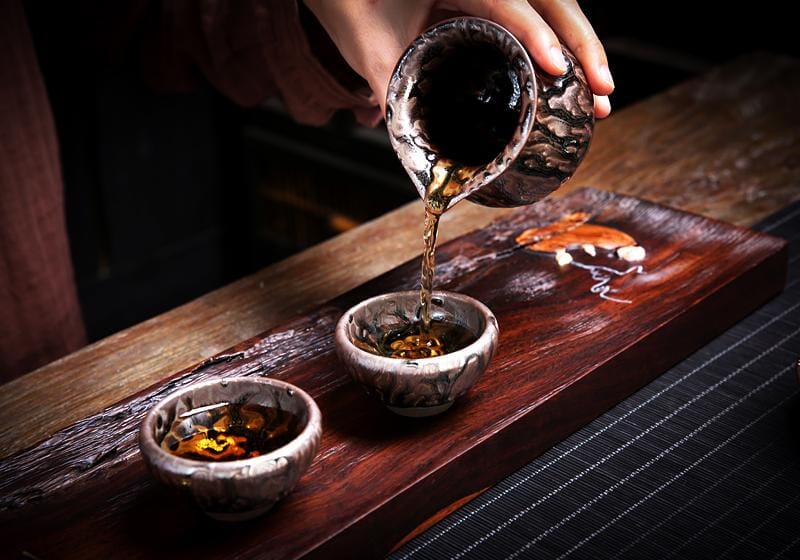
A layout can look spacious until the strainer is lifted off the pitcher. In the scene above, the strainer sits above the pitcher during the transfer. Your rehearsal should also include the next position for it if you take it off before serving. Apply the same check to the gaiwan lid: its resting place should still be available when the cups are in use.
Write a short note with four entries: pieces staying on the tray; pieces staying beside it; landing places needed between pours; movements that failed. This makes two tray options easier to compare than a cup-count label such as “for four people.”
Use the result before choosing more teaware
Send the tray seller this question: “Can you confirm the usable top dimensions inside the border, any openings or raised areas, and the space needed to remove the reservoir or route a drain tube? I want to check my existing teaware layout before ordering.” If those details are unavailable, the fit remains unconfirmed. A styled photograph cannot fill the gap.
For the surrounding room layout, see tea table setup ideas for small homes. For a different question—how much tea reaches each cup—use the gaiwan serving-capacity worksheet.
If you are still choosing the vessels, browse the Tenmokus tea sets collection, check each product's current measurements and included pieces, and return to your outline before choosing a tray. Buy around the session you want to serve.



Share:
How Many Tea Cups Does Your Gaiwan Fill?